Entering Fort Hunt Park, part of the George Washington Memorial Parkway in Virginia
Fort Hunt Park is located near Mount Vernon, along the Potomac River in Northern Virginia, on land once owned by George Washington as part of his River Farm plantation. It is part of the George Washington Memorial Parkway, which is a national park. Though primarily a recreational park, with sports fields, playgrounds and areas for picnics or cookouts, it is also of historic significance.
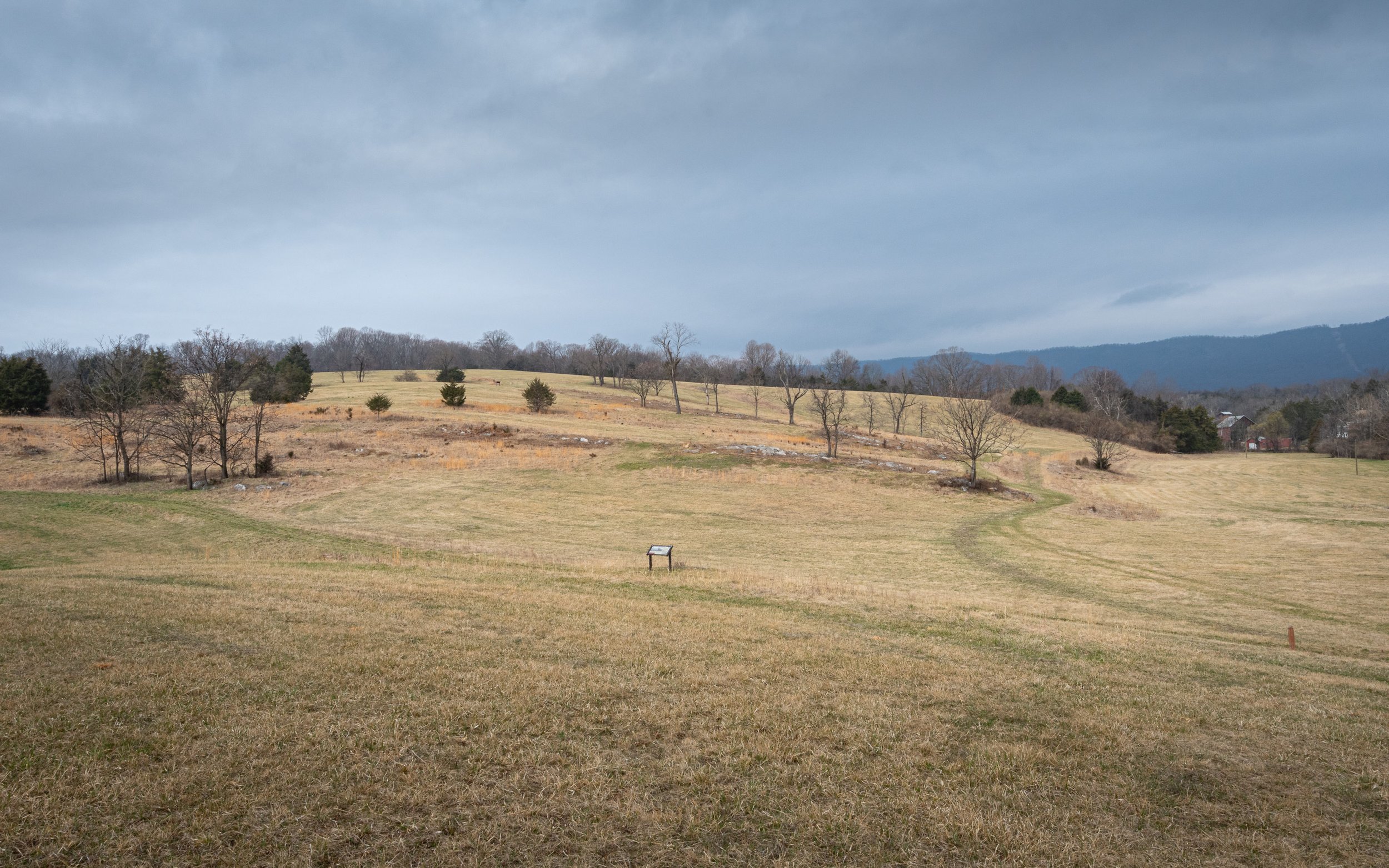
Pavilion A at Fort Hunt Park, located at the main parking area, surrounded by open fields
Fort Hunt was completed in 1897, just in time for the Spanish-American War. It was built as part of the Endicott Coastal Defense System, proposed by Secretary of War William C. Endicott, to upgrade the country’s coastal defenses. Being located on the Potomac River, Fort Hunt, along with Fort Washington, across the river in Maryland, were tasked with protecting Washington, D.C. from naval assault.
A view of Battery Mount Vernon at Fort Hunt Park along the George Washington Memorial Parkway in Virginia.
Though completed before the start of the Spanish-American War, Fort Hunt never actually saw any action during that war. As technology advanced, the coastal defense system provided by installations like Fort Hunt were no longer needed, so its guns were dismantled and sent off to support World War I operations. But the fort continued to be used by the military until the 1930s, when it was converted into a Civilian Conservation Corp camp.
In 1933, Fort Hunt became Fort Hunt Park, part of the George Washington Memorial Parkway, a national park. However, with the onset of World War II, Fort Hunt was temporarily turned back over to the military and used for top secret military intelligence operations. This lasted four years, after which it returned to its status as national park land.
Today you can visit and walk along some of the remains of the military fortifications of Fort Hunt. There are four batteries still located in the park, as well as the Battery Commander’s Station.
Battery Sater
Battery Sater, Fort Hunt Park, Virginia
Battery Sater was completed in 1904 and supported three 3-inch rapid-fire guns with a range of 4.5 miles. It was the last of the four gun batteries completed, and also served as a command center for mines placed in the Potomac River between Fort Hunt and Fort Washington.
One section of Battery Sater from the ground level.
Looking out at Battery Sater from the top level.
A leaf filled walkway of Battery Sater.
A look inside one of the closed off rooms of Battery Sater.
I enjoyed photographing Battery Sater. It was one of the two batteries, along with Battery Mount Vernon, that supported three guns, making it second largest of the structures. There were lots of interesting little nooks and crannies to see while walking its walls. I even tried using the high ISO features of my camera to see into the dark of some of it’s closed off rooms.
Battery Porter
Looking up at Battery Porter, Fort Hunt Park, Virginia
Battery Porter was completed in 1902 and supported one 5-inch rapid-fire gun with a range of 7 miles. This gun was intended to draw enemy ships into range of the larger and more powerful guns of Battery Mount Vernon.
Battery Porter is fairly small, as it supported a single gun, so I didn’t create many photographs of this location.
Battery Robinson
Battery Robinson, just outside the main entrance to Fort Hunt Park, Virginia
Battery Robinson was completed in 1902 and, similar to Battery Porter, supported one 5-inch rapid-fire gun, whose purpose was also to draw enemy ships into range of the larger guns.
Battery Robinson is located just outside the fenced entrance to the park. I photographed it on a different day than the majority of the photos in this post. With the leaves off the trees I noticed you can see the Potomac River from this location.
Battery Mount Vernon
Battery Mount Vernon, Fort Hunt Park, Virginia
Battery Mount Vernon was the first and the largest of the batteries at Fort Hunt. It was completed in 1898 and supported three 8-inch breech loading disappearing guns with a range of 8 miles. They were called disappearing guns because their recoil energy was used to lower them down below the protective walls. When they were reloaded they would be raised back above the walls to fire.
Looking down the length of Battery Mount Vernon, one of the batteries to the left.
Looking out at a battery of Battery Mount Vernon.
Turning away from the battery, towards the rest of the fort.
Looking out of Battery Mount Vernon to the rest of Fort Hunt Park.
Gated off rooms at the lower level of Battery Mount Vernon. Nothing can escape graffiti these days.
Battery Mount Vernon was the most interesting to photograph, as it was the largest and most complex of the structures. You can’t go inside any of these structures (they were closed off to protect the public from the asbestos and other chemicals in use at the time), but it has a lot of interesting elements along the outside. I created a few more artistic photographs of Battery Mount Vernon, including An Eye to the Battery, Facing Down the Tower, and Stepping From the Dark.
Battery Commander’s Station
The Battery Commander’s Station is the tower to the right. Battery Mount Vernon is on the left.
The Battery Commander’s Station was a tower used to observe the Potomac River and direct fire at oncoming ships. It could also be used to signal Fort Washington across the river in Maryland.
I’ve visited Fort Hunt Park a couple times now. It is a small park and easy to see in a short span of time. Of course, with the photographic opportunities of the batteries it would also be easy to spend many hours here. I hope to return during different seasons to see how the scenery around the batteries change. Perhaps I’ll update this page in the future with any new photographs I create.
I wouldn’t necessarily plan a long trip just to visit Fort Hunt Park. But if you’re in the area, or interested in history, it’s well worth the visit if time permits. It is easy to get to, right off the George Washington Memorial Parkway, and is open year-round from sunrise to sunset. If you visit leave a comment below and let me know what you thought of the park and its old fortifications.
Originally posted May 7, 2019. Updated March 2, 2020.
Do you enjoy these posts?
Sign up to receive periodic emails with updates and thoughts. Don’t worry, I won’t spam you. And please consider purchasing artwork or products from my online store, and using my affiliate links in the sidebar to the right when shopping online.
I appreciate your support!