Virginia

Strasburg Museum (Virginia) by Todd Henson

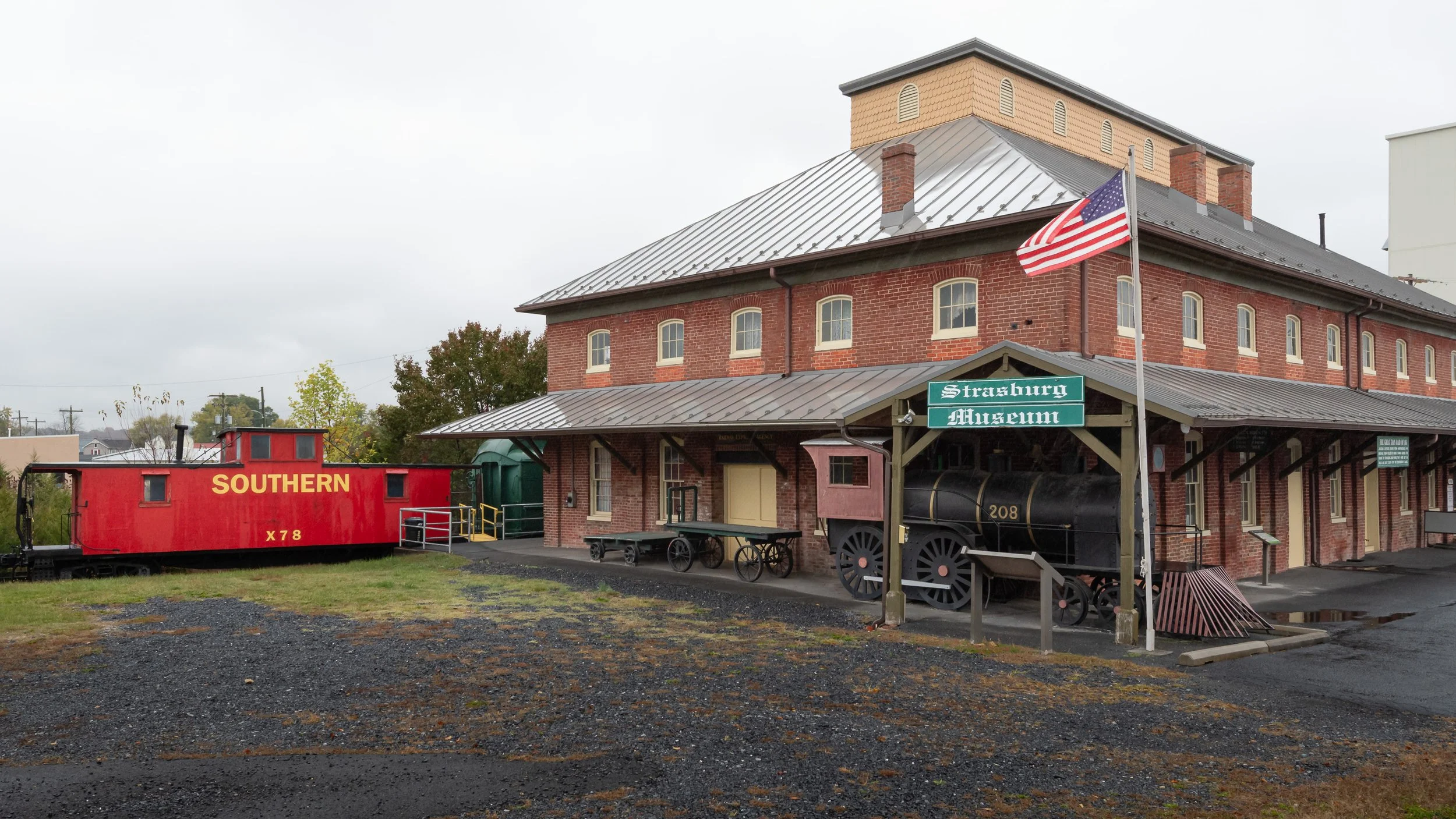
Outside the Strasburg Museum, showing some of their trains.

My father and I have often passed by the Strasburg Museum in Strasburg, Virginia, on our way from one place to another and we kept saying we should stop by there one day. Well, that day finally came at the end of July in 2025. I think it’s fair to say we were both surprised, and pleased, by what we found. It’s such an interesting and yet eclectic museum showcasing many pieces of historical significance to the local area. (Note, the two outdoor photos were made in late October of 2025.)

The museum is two stories with the central part of the building open to the ceiling, so the second floor wraps around that central area allowing you to look down at the main floor. There is also a door out back where, if your timing is right, you might find an open train car with a model railroad display inside.

Main Floor

The photo below shows the view upon entering the museum. It’s a wide open area with flags hanging from the rafters, display cases in the central area and all sorts of display areas along the walls.

A view inside the Strasburg Museum

One of the displays I was drawn to was of a store counter with a phone switchboard to the left and some coffee grinders to the right. Given my love of coffee I suppose it’s natural I’d be drawn to the coffee grinders. 😀

A display of an old store counter

A telephone switchboard

A cash register, coffee grinders and some scales

And like the coffee grinders, I was drawn to some old cameras, including a Target Brownie Six-20 and a Polaroid Land Camera Model 150.

A Target Brownie Six-20 camera, small binoculars, and a photograph

A Polaroid Land Camera Model 150

Both my father and I were a bit surprised to find a view of the covered bridge and church in Stark, New Hampshire in a small town in Virginia. I have written about Stark and my family’s ties to that area in a previous blog post.

An interesting find in a small town in Virginia: a view of the church and covered bridge in Stark, New Hampshire

Upstairs

As soon as you get to the top of the stairs there are a series of display rooms to help take you back a little ways in time.

A view of some of the room displays just upstairs

A beautifully decorated room

A Maryland Treadle Sewing Machine

And the views from upstairs are great, with various displays and items all the way around the floor, and the central area open giving fantastic views of the displays on the main floor.

Upstairs looking towards the back of the museum

Upstairs looking towards the front of the museum (towards the right)

Closing Thoughts

Though I might not travel great distances just to visit the Strasburg Museum, I would certainly recommend a visit if you happen to be in the area. It’s a fascinating museum sure to have something to draw your attention, no matter your interests. Keep in mind it’s in an old building and can get warm and muggy during the worst days of summer, though they open the doors and do the best they can to keep it comfortable. And if you have trouble climbing stairs you may need to skip the upstairs displays, though there is plenty to see on the main floor.

I hope you enjoyed this brief tour of the Strasburg Museum in Strasburg, Virginia. Please note, the museum is open seasonally, from May to October when we visited, and may not be open every day of the week, so check ahead to be sure they’re open before you plan a trip there.

Some Technical Notes

And now let’s talk about some technical aspects of photographing inside the museum. This is a dark museum, as many museums are, so photographing within it required high ISO settings to gather enough light to make a workable exposure. I used an ISO between 1000 and 2500 for all the inside photographs, with most at 2000 or 2500. This meant a fair bit of digital noise so I leveraged Adobe Lightroom’s denoise feature to reduce the noise.

I used two lenses inside the museum, a Nikon 16-35mm f/4, and an Opteka 6.5mm f/3.5 fisheye lens. Both lenses are fairly good in low light situations given their wide apertures, and they are wide angle so I could capture more of the museum in each photo. Most of the photos from the 16-35mm were wide open at f/4, with one at f/5.6, allowing me shutter speeds between 1/15 (very slow for handholding) to 1/200.

The fisheye is a manual lens so the aperture settings weren’t captured in the metadata but given some of the starburst flares from the hanging lights I must have stopped down a fair bit (to a smaller aperture). The shutter speeds with the fisheye were between 1/20 to 1/160, with most on the slower side.

I did the best I could to stabilize the camera while handholding, given the range of very slow shutter speeds. It’s a bit easier to do and still get reasonable sharpness with wide angles. I did attempt to correct as much of the wide angle and fisheye distortion as I could in the software, though you’ll still see some curving lines and some softness around the edges of some frames. Overall, though, I’m very pleased with how it all worked out.

Another view of the outside of the Strasburg Museum in Strasburg, Virginia


Do you enjoy these posts?

Sign up to receive periodic emails with updates and thoughts. Don’t worry, I won’t spam you. And please consider purchasing artwork or products from my online store, and using my affiliate links in the sidebar to the right when shopping online.

I appreciate your support!



Street Scenes on East Davis Street, Culpeper, Virginia by Todd Henson

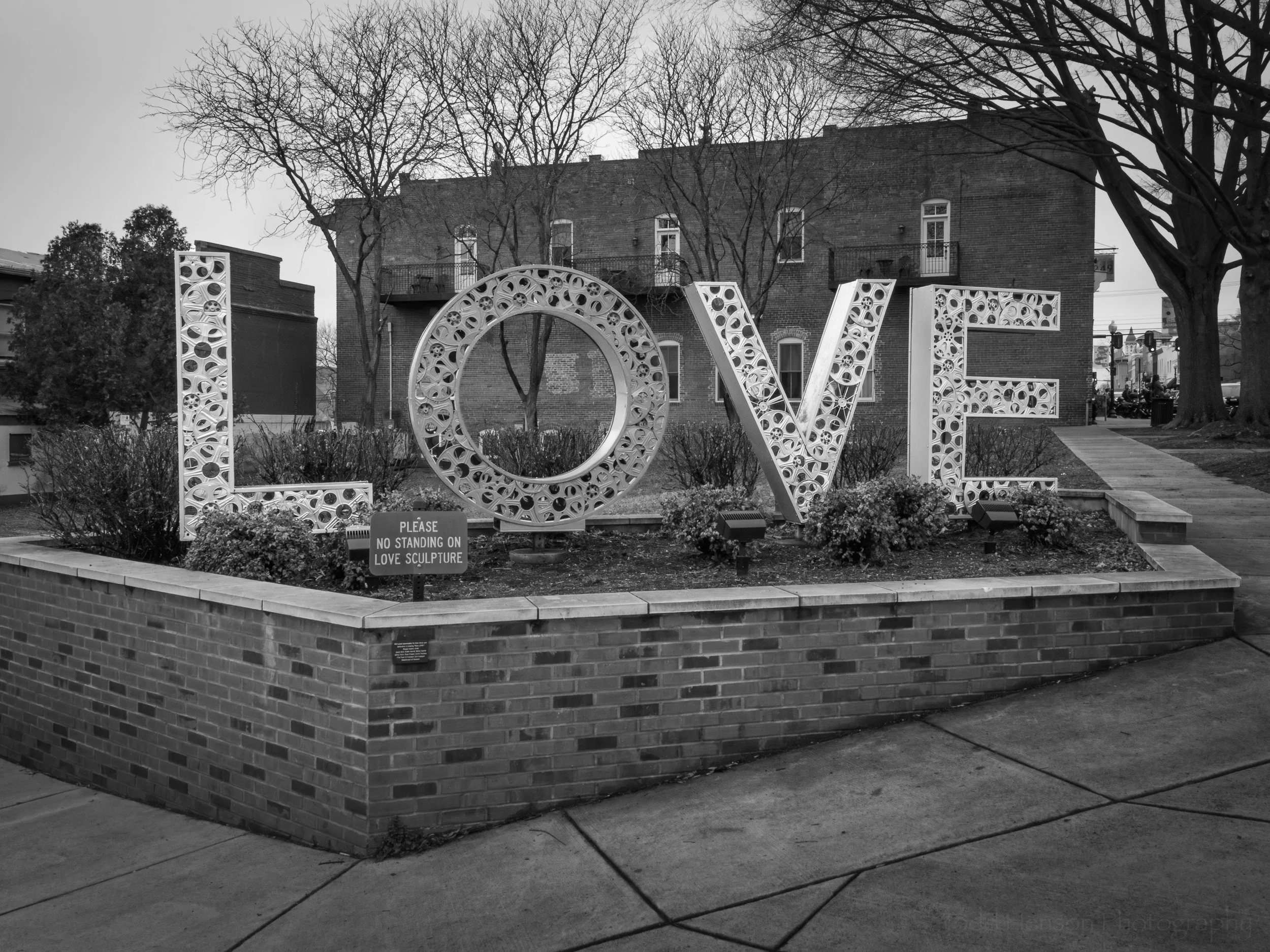
LOVE in Culpeper, Virginia

In early March of 2026 my father and I visited Culpeper, Virginia. We stopped by the Museum of Culpeper History at the train depot, and afterwards I walked up and down East Davis Street photographing some street scenes. I don’t often practice street photography but I found I quite enjoyed it. I hope you enjoy some of the results of my attempts.

A view up East Davis Street in Culpeper, Virginia

Bikes on East Davis Street

Yowell Hardware

East Davis Street motorcycle gathering

East and Davis Streets in Culpeper, Virginia

Gospel Tabernacle Assembly of God Church in Culpeper, Virginia

The end of East Davis Street in Culpeper, Virginia

Suites off East Davis, a boutique hotel in Culpeper, Virginia


Do you enjoy these posts?

Sign up to receive periodic emails with updates and thoughts. Don’t worry, I won’t spam you. And please consider purchasing artwork or products from my online store, and using my affiliate links in the sidebar to the right when shopping online.

I appreciate your support!

Aldie Mill Historic Park - Loudoun County, Virginia by Todd Henson

From left to right: country mill, merchant mill, granary (almost hidden behind merchant mill), and storehouse (white building)

Part of the Northern Virginia Regional Park Authority, Aldie Mill Historic Park preserves a small piece of local Loudoun County history. It was in operation from 1808 to 1971 and in the 1800s and early 1900s was a busy operation, both grinding local farmer’s corn and wheat into flour, meal and feed for family use, but mostly creating products that were transported to the ports of Alexandria and from there to markets in the east and overseas.

The merchant mill and the granary at Aldie Mill Historic Park in Loudoun County, Virginia

The front of the merchant mill at Aldie Mill Historic Park

Charles Fenton Mercer found this ideal location just along the almost complete Little River Turnpike (U.S. 50) which would connect Aldie with Alexandria. Just a bit to the west it would hook up with turnpikes through Ashby’s Gap and Snicker’s Gap in the Blue Ridge. There were the waters of Little River to power the water wheels, and Loudoun County’s farms were a great source of the needed grains.

The back of the merchant mill shows the two water wheels and the granary in the background to the left

A closer look at the water wheels of the merchant mill at Aldie Mill

The site includes several buildings:

Aldie Mill 39401

  • A storehouse, the white building all the way to the right in one of the photos, was originally used as both a store and storehouse, and was later converted to a residence for mill workers and their families.

  • Grain waiting to be ground was stored in the granary, between the storehouse and the merchant mill. There were conveyors moving grain both ways between granary and merchant mill.

  • The merchant mill had a mechanical system of chutes and belts that moved grain between the various stages of processing. You can see the two water wheels at the back of the merchant mill in a couple of the photos. Some of the products of the merchant mill were sold in the store but the majority were transported to Alexandria.

  • Farmer’s brought their grain to the smaller country mill, where it was ground into flour, meal and feed for their family’s uses. It ceased operation in the late 19th century and was then used to store feed and other items.

A door at the mill

We visited this park in late November of 2025, which is during their off-season. It was a cold, somewhat overcast, and quiet day, though there were several other people who stopped by and walked the grounds while we were there. If you visit earlier in the year you might be able to enter some of the buildings and perhaps see demonstrations of what went on at the mill when it was actively in use. This is one of those almost hidden little gems that we may have driven by several times without realizing what it was. It does appear to be a less visited park and because of that some of the signage is rather old, faded, darkened, and difficult to read. But I’m glad we visited and I might enjoy visiting during their open season to see what else we might learn of the history of this region.


Do you enjoy these posts?

Sign up to receive periodic emails with updates and thoughts. Don’t worry, I won’t spam you. And please consider purchasing artwork or products from my online store, and using my affiliate links in the sidebar to the right when shopping online.

I appreciate your support!