Museums

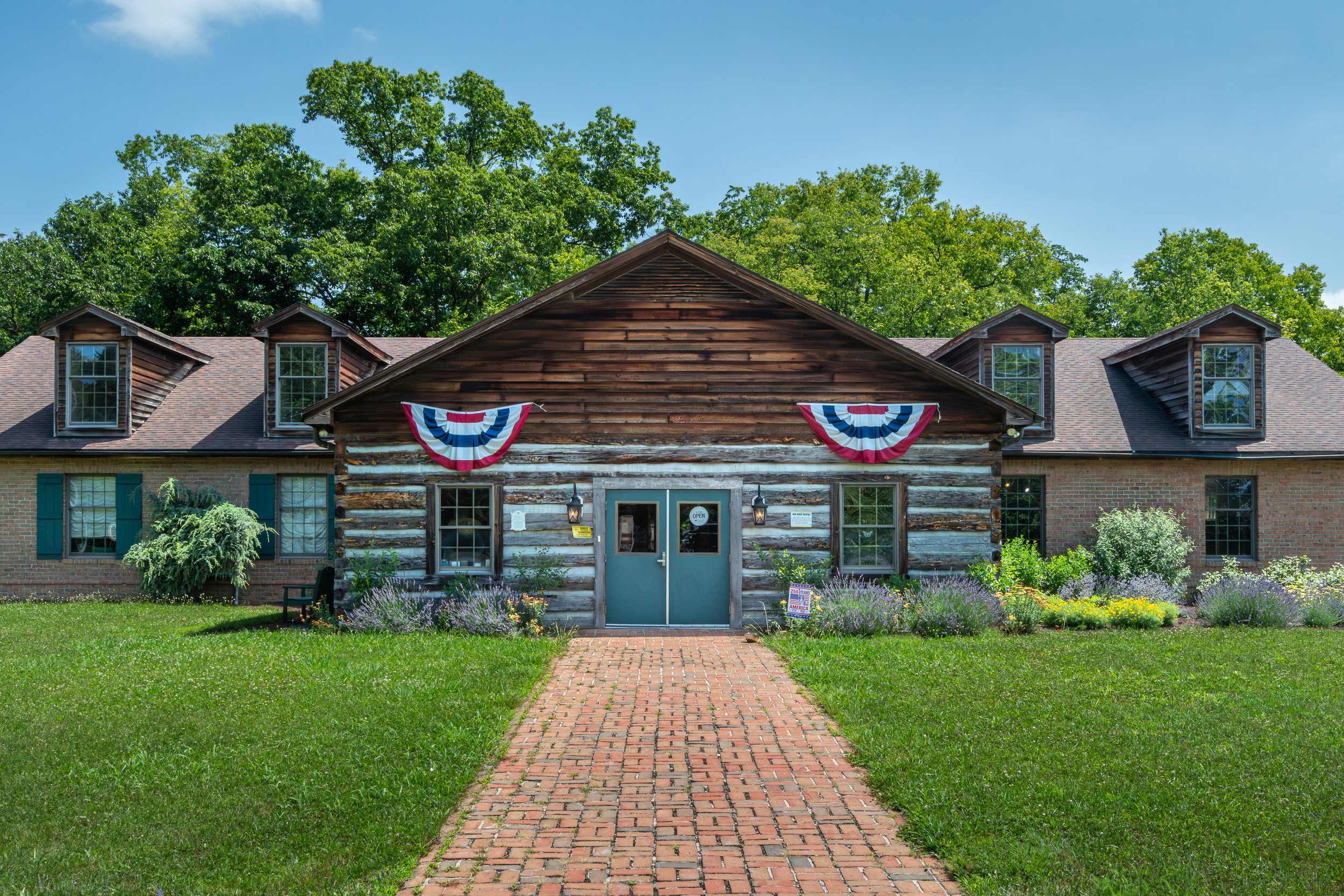
Strasburg Museum (Virginia) by Todd Henson

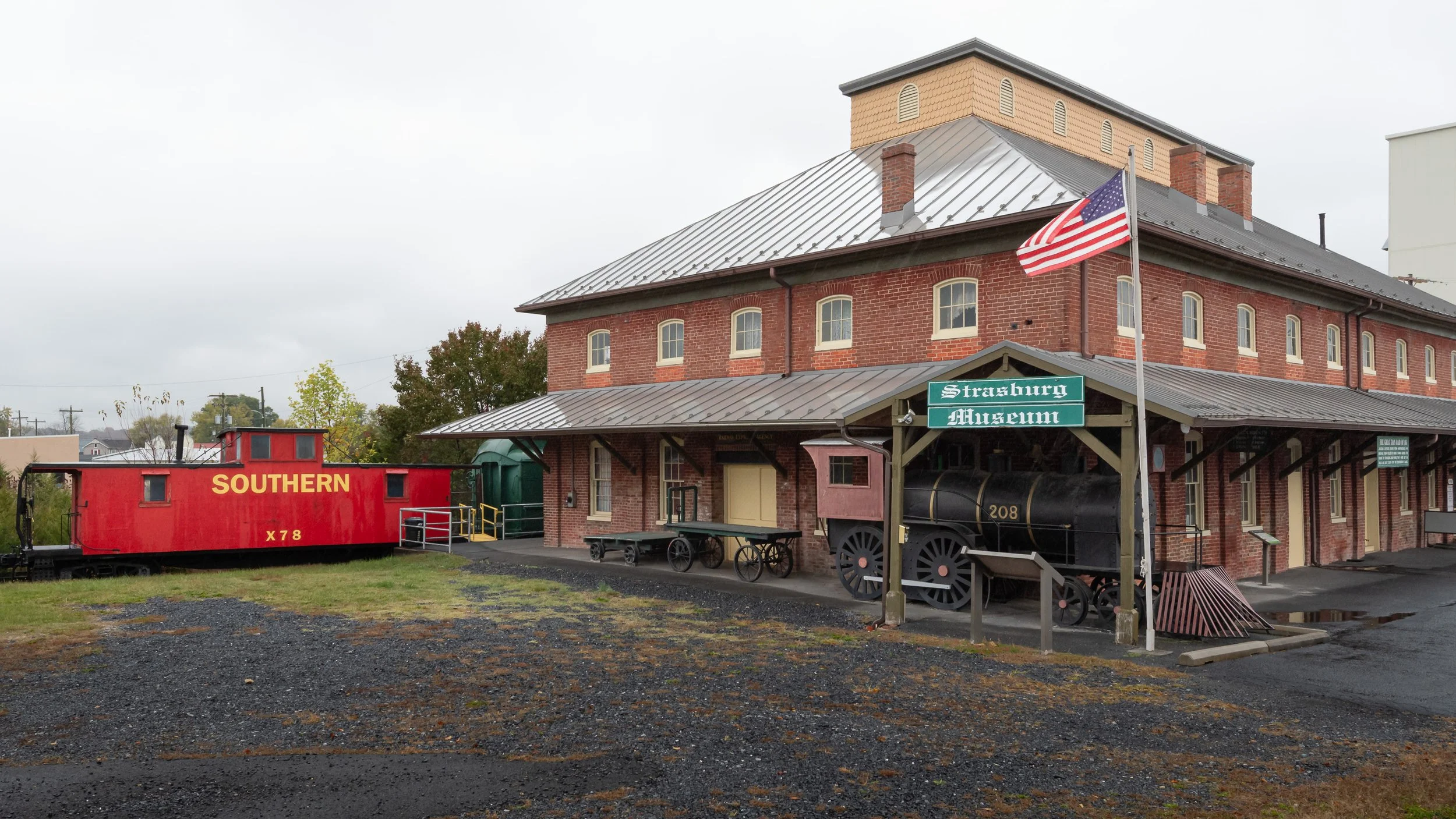
Outside the Strasburg Museum, showing some of their trains.

My father and I have often passed by the Strasburg Museum in Strasburg, Virginia, on our way from one place to another and we kept saying we should stop by there one day. Well, that day finally came at the end of July in 2025. I think it’s fair to say we were both surprised, and pleased, by what we found. It’s such an interesting and yet eclectic museum showcasing many pieces of historical significance to the local area. (Note, the two outdoor photos were made in late October of 2025.)

The museum is two stories with the central part of the building open to the ceiling, so the second floor wraps around that central area allowing you to look down at the main floor. There is also a door out back where, if your timing is right, you might find an open train car with a model railroad display inside.

Main Floor

The photo below shows the view upon entering the museum. It’s a wide open area with flags hanging from the rafters, display cases in the central area and all sorts of display areas along the walls.

A view inside the Strasburg Museum

One of the displays I was drawn to was of a store counter with a phone switchboard to the left and some coffee grinders to the right. Given my love of coffee I suppose it’s natural I’d be drawn to the coffee grinders. 😀

A display of an old store counter

A telephone switchboard

A cash register, coffee grinders and some scales

And like the coffee grinders, I was drawn to some old cameras, including a Target Brownie Six-20 and a Polaroid Land Camera Model 150.

A Target Brownie Six-20 camera, small binoculars, and a photograph

A Polaroid Land Camera Model 150

Both my father and I were a bit surprised to find a view of the covered bridge and church in Stark, New Hampshire in a small town in Virginia. I have written about Stark and my family’s ties to that area in a previous blog post.

An interesting find in a small town in Virginia: a view of the church and covered bridge in Stark, New Hampshire

Upstairs

As soon as you get to the top of the stairs there are a series of display rooms to help take you back a little ways in time.

A view of some of the room displays just upstairs

A beautifully decorated room

A Maryland Treadle Sewing Machine

And the views from upstairs are great, with various displays and items all the way around the floor, and the central area open giving fantastic views of the displays on the main floor.

Upstairs looking towards the back of the museum

Upstairs looking towards the front of the museum (towards the right)

Closing Thoughts

Though I might not travel great distances just to visit the Strasburg Museum, I would certainly recommend a visit if you happen to be in the area. It’s a fascinating museum sure to have something to draw your attention, no matter your interests. Keep in mind it’s in an old building and can get warm and muggy during the worst days of summer, though they open the doors and do the best they can to keep it comfortable. And if you have trouble climbing stairs you may need to skip the upstairs displays, though there is plenty to see on the main floor.

I hope you enjoyed this brief tour of the Strasburg Museum in Strasburg, Virginia. Please note, the museum is open seasonally, from May to October when we visited, and may not be open every day of the week, so check ahead to be sure they’re open before you plan a trip there.

Some Technical Notes

And now let’s talk about some technical aspects of photographing inside the museum. This is a dark museum, as many museums are, so photographing within it required high ISO settings to gather enough light to make a workable exposure. I used an ISO between 1000 and 2500 for all the inside photographs, with most at 2000 or 2500. This meant a fair bit of digital noise so I leveraged Adobe Lightroom’s denoise feature to reduce the noise.

I used two lenses inside the museum, a Nikon 16-35mm f/4, and an Opteka 6.5mm f/3.5 fisheye lens. Both lenses are fairly good in low light situations given their wide apertures, and they are wide angle so I could capture more of the museum in each photo. Most of the photos from the 16-35mm were wide open at f/4, with one at f/5.6, allowing me shutter speeds between 1/15 (very slow for handholding) to 1/200.

The fisheye is a manual lens so the aperture settings weren’t captured in the metadata but given some of the starburst flares from the hanging lights I must have stopped down a fair bit (to a smaller aperture). The shutter speeds with the fisheye were between 1/20 to 1/160, with most on the slower side.

I did the best I could to stabilize the camera while handholding, given the range of very slow shutter speeds. It’s a bit easier to do and still get reasonable sharpness with wide angles. I did attempt to correct as much of the wide angle and fisheye distortion as I could in the software, though you’ll still see some curving lines and some softness around the edges of some frames. Overall, though, I’m very pleased with how it all worked out.

Another view of the outside of the Strasburg Museum in Strasburg, Virginia


Do you enjoy these posts?

Sign up to receive periodic emails with updates and thoughts. Don’t worry, I won’t spam you. And please consider purchasing artwork or products from my online store, and using my affiliate links in the sidebar to the right when shopping online.

I appreciate your support!


Smithsonian National Museum of African Art by Todd Henson

Garden entrance to the Smithsonian National Museum of African Art

The Smithsonian’s National Museum of African Art is located in Washington, D.C., along the National Mall and just across from the Arthur M. Sackler Gallery. These two museums are separated by a beautiful outdoor garden and share a very similar look to their exterior architecture. The majority of each museum is located below ground, and the two museums actually connect to one another through a lower-level hallway.

Beautiful stairwell in the National Museum of African Art

I love all of the Smithsonian museums I’ve had the pleasure to visit. Not only do they each contain amazing works of art, culture, or engineering, they also were built by very creative architects. There are so many fantastic elements to these buildings, and the National Museum of African Art is no different. I was drawn to one of the stairwells, lit from a skylight overhead and from an entryway above.

Contact by Nandipha Mntambo, viewed through an entryway

This museum contained artwork and cultural items from all over the African continent. Some were very old relics and others were more modern works of art. The piece that most stood out for me this trip was titled Contact, created by Nandipha Mntambo from Swaziland. It’s a sculpture cast from the artist’s body and covered in cowhide and cow hooves, and was inspired by a ship’s figurehead. The piece is beautifully displayed on a dark brown wall, with spotlights highlighting the artwork. I first viewed the piece through an entryway from another part of the museum, and I was immediately transfixed by this piece. Something about it spoke to me.

Contact by Nandipha Mntambo, displayed in the National Museum of African Art

We walked through several other rooms full of interesting and beautiful pieces. Below are images from some of the ones I was most drawn to.

Crest Mask, part of the Walt Disney-Tishman African Art Collection at the National Museum of African Art

The Crest Mask is part of the Walt Disney-Tishman African Art Collection, which is a current highlight of the museum.

Ethiopian shield made from leather and silver alloy

I’ve always been drawn to arms and armor from different cultures and times, so I was pulled in by the Ethiopian shield made from leather and silver alloy. It’s an amazing piece.

Silver coffee pot from the Sultanate of Oman

I loved the details and the shapes of the silver coffee pot from the Sultanate of Oman.

Swahili chest from Tanzania

Ornate Swaili chest from Tanzania

Swahili door and frame from Tanzania

In the corner of one gallery hall were an ornate chest displayed in front of a door in its frame. These were both Swahili pieces from Tanzania. I was fascinated by the details and the craftsmanship.

The Smithsonian’s National Museum of African Art is a fantastic museum. I highly recommend you visit if you have the opportunity. These Smithsonian museums really are a treasure, one I hope to revisit many times. Have you ever visiting the National Museum of African Art? Which pieces were you most drawn to?


Do you enjoy these posts?

Sign up to receive periodic emails with updates and thoughts. Don’t worry, I won’t spam you. And please consider purchasing artwork or products from my online store, and using my affiliate links in the sidebar to the right when shopping online.

I appreciate your support!


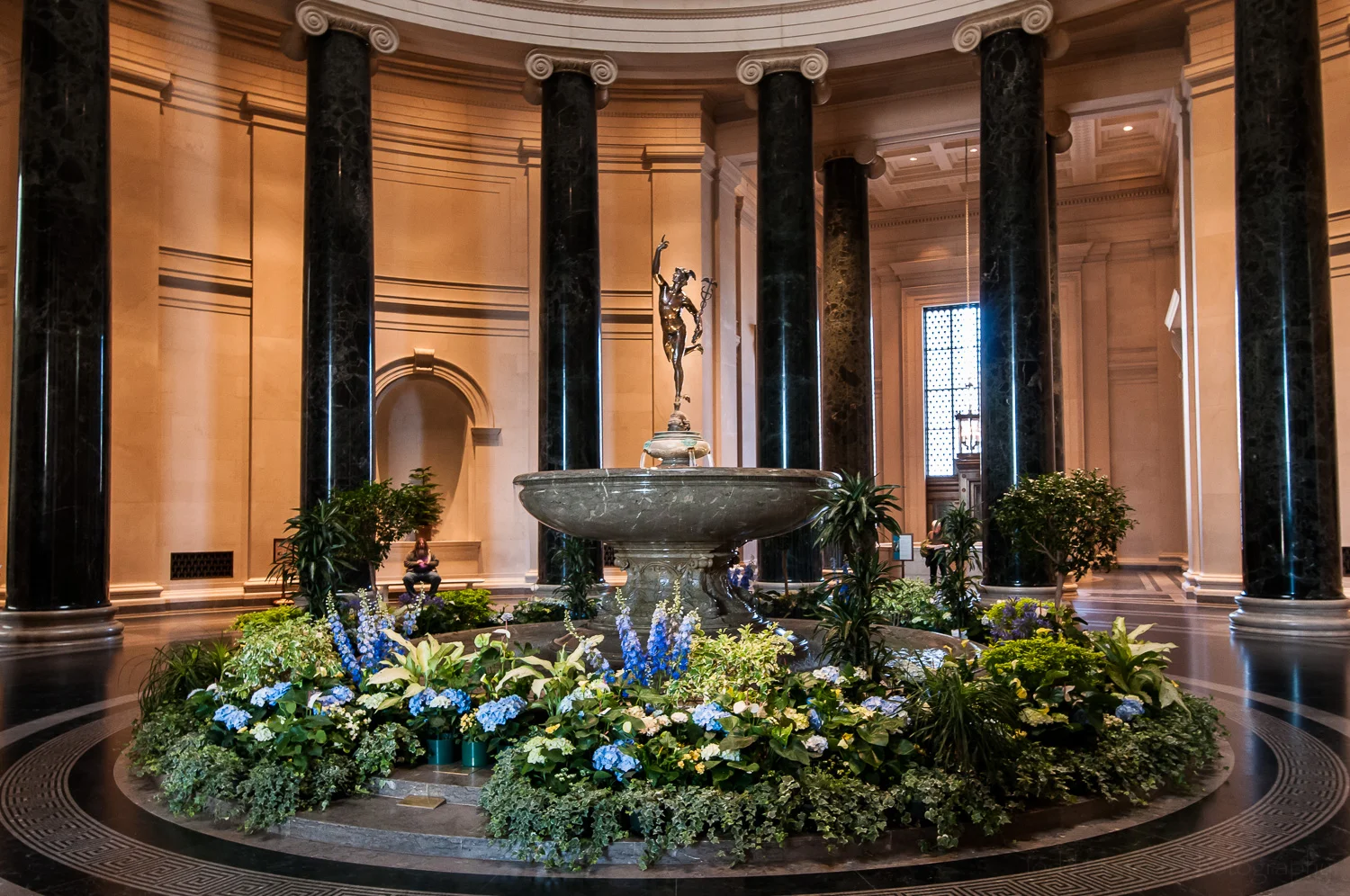
Smithsonian Arthur M. Sackler Gallery by Todd Henson

Garden entrance to the Arthur M. Sackler Gallery in Washington, D.C.

Flower display in the Sackler Gallery entrance. These are a continuing gift of Else Sackler.

The Arthur M. Sackler Gallery and the Freer Gallery of Art are the Smithsonian’s museums of Asian art. These museums are located in Washington, D.C., along the National Mall. A few weeks back my brother and I visited some of the Smithsonian museums, the Sackler being one of them. The Freer Gallery was closed for renovations when we visited, and is scheduled to reopen in October 2017.

One of the first exhibits we viewed was a fantastic suspended sculpture, titled Monkeys Grasp for the Moon, designed for the Sackler by Chinese artist Xu Bing. It consists of twenty-one laminated wood pieces, all hung together to form a long chain hanging in one of the gallery’s stairwells. The wood pieces spell the word monkey in a dozen different languages. It’s a fascinating piece and beautifully displayed.

Side view of Monkeys Grasp for the Moon by Xu Bing in the Sackler Gallery

Looking down at Monkeys Grasp for the Moon by Xu Bing in the Sackler Gallery

The Sackler contains sculptures from all over Asia. Included here are a sampling of some of these wonderful pieces.

Shiva Nataraja (Lord of the Dance) at the Sackler Gallery

Indian Figure of Shiva at the Sackler Gallery

Head From a Figure of the Buddha at the Sackler Museum

Shiva Vinadhara (Holder of the Vina) at the Sackler Gallery

One of the major exhibits was titled Chinamania, and consisted of many pieces of Chinese porcelain. In the first room we see two large stupas built from many porcelain sculptures. The nearest stupa is called the Dark Stupa and the further one the White Stupa. They’re displayed in a dark room with fantastic lighting, focusing the eye right on the two stupas. I was really drawn to this display. So much detail, with all the individual porcelain pieces making up the larger sculptures. Fantastic!

Chinamania Dark and White Stupa at the Sackler Gallery

Chinamania White Stupa at the Sackler Gallery

Check out a video showing the creation of the Dark and White Stupa:

Next to the Dark and White Stupa is Filthy Lucre, an entire room that reimagines the original Peacock Room. The room, designed by Darren Waterston, is very dark with red and white lights shining in key locations. It is full of shelves, many collapsing, containing various porcelain pieces. It is a very dark and moody room.

Filthy LucrePeacock Room ReMix at the Sackler Gallery

Watch the story behind Filthy Lucre:

And here’s a behind the scenes video of the creation of Filthy Lucre:

Just beyond Filthy Lucre is a beautiful display of blue and white ceramics from China’s Kangxi period. These are also in a very dark room, but are arranged in lit shelves. It’s a very beautiful display.

Chinamania Blue & White Porcelain at the Sackler Gallery

The final display we viewed was the Turquoise Mountain exhibit, which was a room full of works created by modern Afghan artisans. The room opened with displays of woodwork, encouraging visitors to touch the work and see and feel the craftsmanship. There were a number of large carpets displayed, along with ceramics, jewelry, and various other crafts. It was a very beautifully designed room with a large central gazebo with cushioned seats.

Turquoise Mountain exhibit at the Sackler Gallery

I was most impressed with the lighting in the Sackler. Many of the displays and exhibits were just beautifully lit. Many were in dark locations with the light specifically focused on the display, drawing your attention right there. It was easy to lose track of everything else, even other people in the museum. Everything but the display faded into the background, leaving just you and the artwork. I really enjoyed this. We photographers can certainly learn a little about lighting by studying the ways displays are lit in museums such as this.

I would strongly encourage you to visit the Smithsonian’s Sackler Gallery if you have the opportunity. And if you have already visited let me know what you thought of it. What were the major exhibits when you visited?


Do you enjoy these posts?

Sign up to receive periodic emails with updates and thoughts. Don’t worry, I won’t spam you. And please consider purchasing artwork or products from my online store, and using my affiliate links in the sidebar to the right when shopping online.

I appreciate your support!