Angular Flow No. 1 by Todd Henson

Angular Flow No. 1

The Story

Angular Flow No. 1 is a more abstract photograph than I usually create. It depicts water flowing over a dam above Great Falls on the Potomac River, which flows between Maryland and Virginia and past Washington, DC.

I had been on the Maryland side of the river photographing the falls and also some of the many Great Blue Herons that congregate at the falls looking for fish. A little later in the day, while standing on a platform overlooking the dam above the falls I was taken by the interesting lines and tones as the water flowed over the dam.

I liked the look of the flowing water, and how the dam created a distinct line between the darker water above the dam and the lighter water below the dam. I figured a slow shutter speed would accentuate this, smoothing out the water and showing all the different tones, helping with the abstract nature of the scene.

The Technique

I wanted a slow shutter speed but I didn’t have a neutral density filter with me, so instead I stopped the aperture of my lens down as far as it would go, f/36 in this case. Stopping down the aperture limits the amount of light that gets through the lens to the camera sensor. That’s why it lets you use a slower shutter speed, the sensor needs more time to collect enough light for the exposure.

Stopping down the aperture also increases the depth of field. I wasn’t all that worried about the depth of field in this case, but it does help assure the line of water going over the dam is in focus.

Be aware, using very small apertures can also adversely affect the sharpness of a photograph due to diffraction. In this case I wasn’t as worried about that, as the subject was flowing water. But you may notice your photos are a little soft when you use the smallest aperture. If this happens open the aperture a little more.

Setting an aperture of f/36 and keeping my ISO as low as I could (ISO 200) let me keep the shutter open for 5 seconds (requiring a tripod), creating just the sort of look I was after.

The Processing

Below you can see the raw image I started with before making any adjustments in Adobe Lightroom. This is an unprocessed raw, so it is naturally a little flat. I didn’t think the rocks in the background added anything to the image, as I was most interested in the water, itself. So I cropped out the top part of the image. I also noticed the rocks were not very sharp.

The original raw image for Angular Flow No. 1

Next I tweaked the white balance and made various other adjustments to bring out a little more contrast between the different parts of the frame. As you can see below, the blue, reflected from the sky, begins to look a little unrealistic. But I had in mind a monochromatic photograph to concentrate on just the tones and lines so I wasn't worried about how the colors looked, just how the contrast and patterns looked.

Initial color processing of Angular Flow No. 1

Finally, I converted the image to black and white and tweaked all the color channels to adjust the levels of grey associated with each color. I brought up the whites and darkened down the blacks. In the color images the water flow was not quite horizontal, there was a slight upward tilt towards the left. So I rotated the image just slightly to make the water flow more horizontal. I thought about cropping such that the diagonal line of the dam ran from one corner to the other but I actually preferred the look where the line ends just above and below the corners.

Angular Flow No. 1 - The final version in black and white

Let me know what you think in the comments below. Would you have done things any differently?


Do you enjoy these posts?

Sign up to receive periodic emails with updates and thoughts. Don’t worry, I won’t spam you. And please consider purchasing artwork or products from my online store, and using my affiliate links in the sidebar to the right when shopping online.

I appreciate your support!

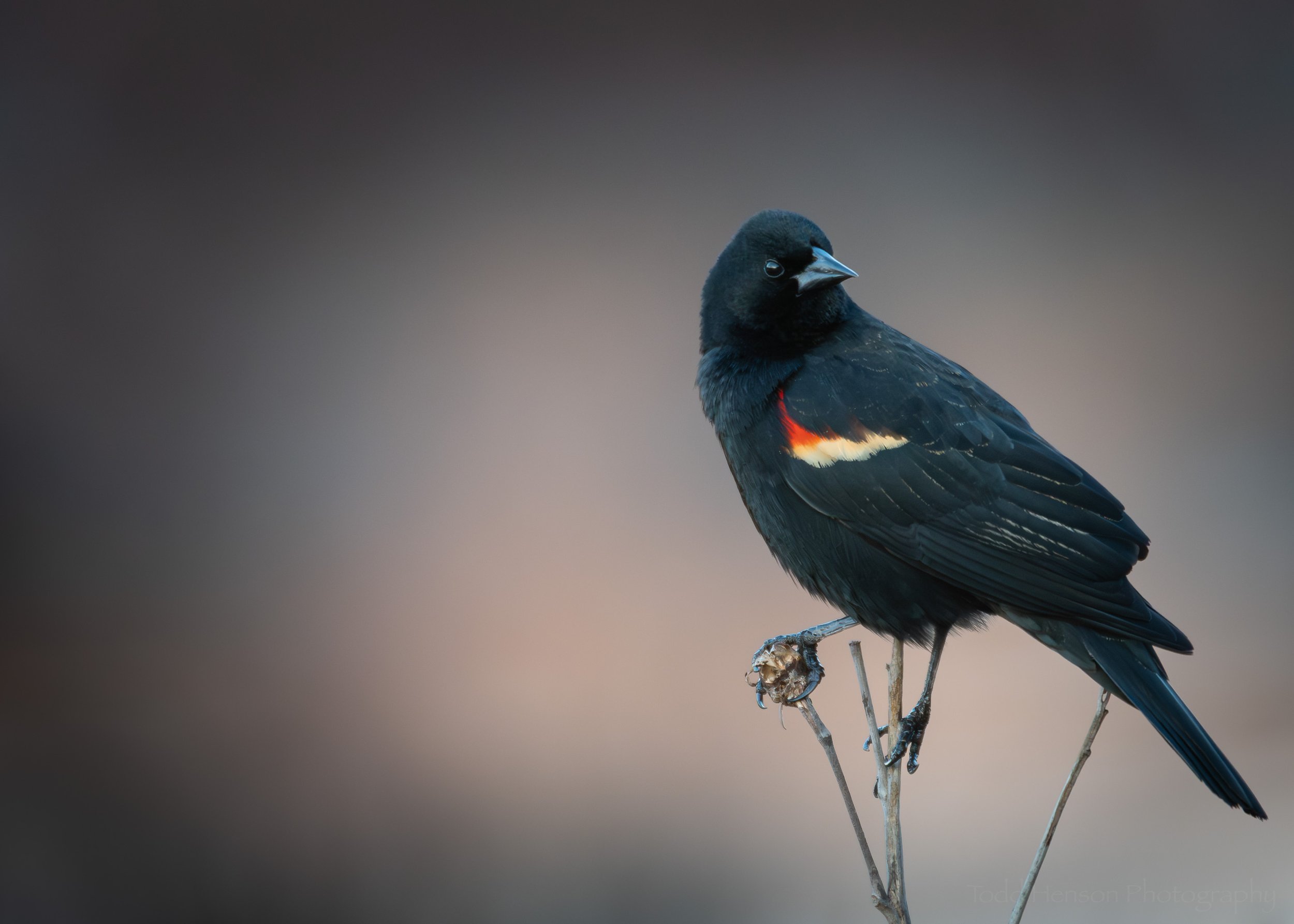
Fledged Red-winged Blackbird by Todd Henson

Drawn by the sound of my camera's shutter, the Red-winged Blackbird fledgling looks my way.

In this post we take a look at a fledged Red-winged Blackbird sitting on a perch in the wetlands waiting for a parent to return to feed it. The fledgling appears to be maturing nicely, but is still young enough to rely on its parents.

The fledged Red-winged Blackbird looks up, likely watching some other bird fly overhead.

The coloration of its feathers are those of both adolescent and female Red-winged Blackbirds, namely a pattern of light and dark brown. You can see the ends of many feathers stick out, they’re not yet smooth. You can also tell from its face that it is a fledgling. The feathers on the face have not yet fully grown in.

The young Red-winged Blackbird closes its eyes and takes a short nap.

This particular fledgling didn’t move around much while I observed it. In fact, at one point it closed its eyes and appeared to nap. And it remained completely quiet, as well, though I suspect it would have begun making quite a noise if it saw a parent approaching.

Parting image of the young fledged Red-winged Blackbird.

Keep your eyes open when you’re out in the field. There’s plenty to see if you stay observant.


Do you enjoy these posts?

Sign up to receive periodic emails with updates and thoughts. Don’t worry, I won’t spam you. And please consider purchasing artwork or products from my online store, and using my affiliate links in the sidebar to the right when shopping online.

I appreciate your support!


Himalaya: Land of the Snow Lion by Andrea Baldeck by Todd Henson

This post contains affiliate links and I will be compensated if you make a purchase after clicking on my links. This is at no extra cost to you.

The cover of Andrea Baldeck's Himalaya: Land of the Snow Lion.

The cover of Andrea Baldeck's Himalaya: Land of the Snow Lion.

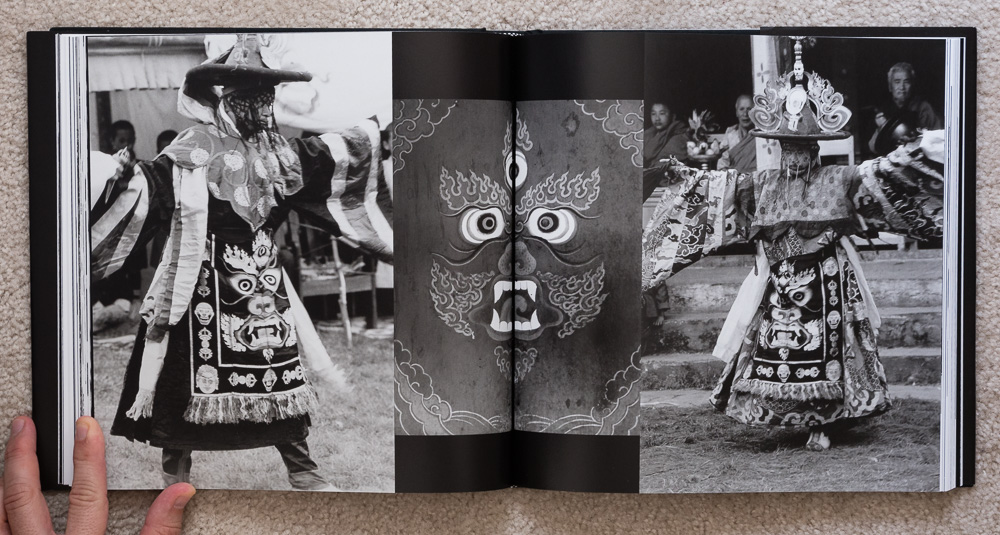
Andrea Baldeck is a photographer, a traveller, a musician, and a physician. She made four journeys to the Himalayas and collected photographs from these journeys into the book Himalaya: Land of the Snow Lion. The photos showcase the rugged landscape of the mountains, the villages, dwellings, and monasteries, and the people of the region.

Pages 22 - 23 of Andrea Baldeck's Himalaya: Land of the Snow Lion.

Pages 22 - 23 of Andrea Baldeck's Himalaya: Land of the Snow Lion.

Pages 64 - 65 of Andrea Baldeck's Himalaya: Land of the Snow Lion.

Pages 64 - 65 of Andrea Baldeck's Himalaya: Land of the Snow Lion.

The book is over 240 pages, printed on thick paper, and almost completely filled with photographs. Interspersed within are six short one-page essays that give some context to the photographs, describing the people, the culture, the religions and beliefs, and how they all fit together in the region, sometimes peacefully and sometimes less so.

Pages 98 - 99 of Andrea Baldeck's Himalaya: Land of the Snow Lion.

Pages 98 - 99 of Andrea Baldeck's Himalaya: Land of the Snow Lion.

Pages 120 - 121 of Andrea Baldeck's Himalaya: Land of the Snow Lion.

Pages 120 - 121 of Andrea Baldeck's Himalaya: Land of the Snow Lion.

Himalayan travel removes one from the familiar, wrenches one from complacency, and rewards with rich insights and singular experiences.
— Himalaya: Land of the Snow Lion, page 7
Pages 128 - 129 of Andrea Baldeck's Himalaya: Land of the Snow Lion.

Pages 128 - 129 of Andrea Baldeck's Himalaya: Land of the Snow Lion.

Pages 160 - 161 of Andrea Baldeck's Himalaya: Land of the Snow Lion.

Pages 160 - 161 of Andrea Baldeck's Himalaya: Land of the Snow Lion.

Himalaya: Land of the Snow Lion is one of those books that helps people appreciate another culture, or multiple other cultures,  even when there is little chance of ever traveling to the locations and learning about them first hand. Baldeck’s photographs take us into the region, into the lives of the people. We get to see a little of their culture, some of their traditions, and some of the beautiful artwork and architecture that reflects the culture and beliefs of the region.

Pages 168 - 169 of Andrea Baldeck's Himalaya: Land of the Snow Lion.

Pages 168 - 169 of Andrea Baldeck's Himalaya: Land of the Snow Lion.

Pages 196 - 197 of Andrea Baldeck's Himalaya: Land of the Snow Lion.

Pages 196 - 197 of Andrea Baldeck's Himalaya: Land of the Snow Lion.

Ethnicity, faith, and tradition rarely recognize the borders of nation-states, and often outlive them. The power of images to illuminate their story may enhance the survival of a unique way of life in a place like no other. May the people of the Himalaya, like the snow lion, ever roam and roar in these mountains.
— Himalaya: Land of the Snow Lion, page 195

I believe this book will appeal to anyone interested in the cultures throughout the Himalayas. It takes us on a short visual excursion through this region. The photos are ones I would expect to see in an issue of National Geographic. They do a great job of visually telling the story of the people, showing wide landscape views of the region, taking us to the dwellings and monasteries, showing the people both in portraits, in their daily lives, and at festivals. They also zoom in to show details, from a ladder leaning against a hut, to the contents of a table, to details of sculptures and architecture. If any of these things appeal to you then seek out a copy of Himalaya: Land of the Snow Lion by Andrea Baldeck.