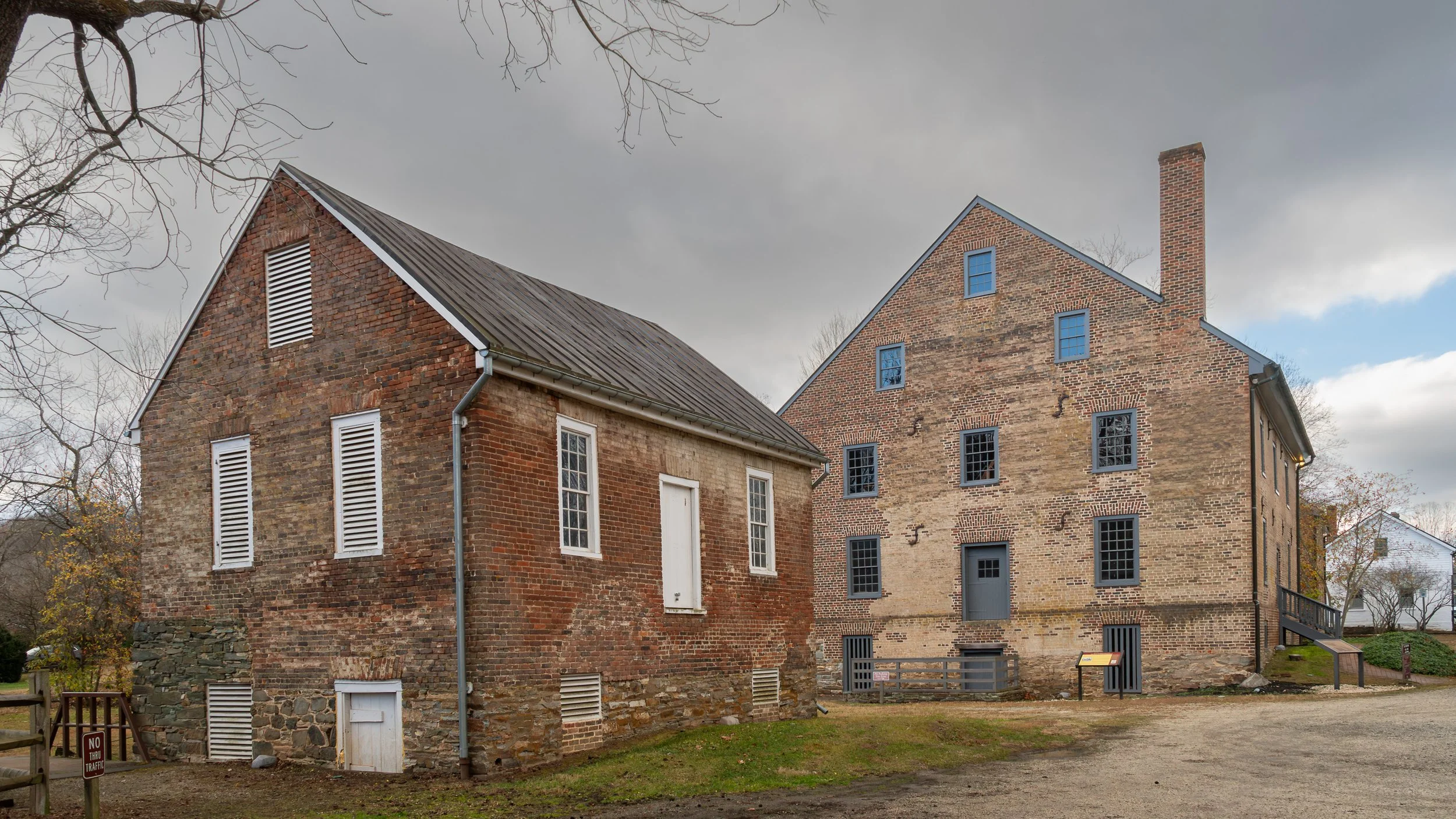
From left to right: country mill, merchant mill, granary (almost hidden behind merchant mill), and storehouse (white building)
Part of the Northern Virginia Regional Park Authority, Aldie Mill Historic Park preserves a small piece of local Loudoun County history. It was in operation from 1808 to 1971 and in the 1800s and early 1900s was a busy operation, both grinding local farmer’s corn and wheat into flour, meal and feed for family use, but mostly creating products that were transported to the ports of Alexandria and from there to markets in the east and overseas.
The merchant mill and the granary at Aldie Mill Historic Park in Loudoun County, Virginia
The front of the merchant mill at Aldie Mill Historic Park
Charles Fenton Mercer found this ideal location just along the almost complete Little River Turnpike (U.S. 50) which would connect Aldie with Alexandria. Just a bit to the west it would hook up with turnpikes through Ashby’s Gap and Snicker’s Gap in the Blue Ridge. There were the waters of Little River to power the water wheels, and Loudoun County’s farms were a great source of the needed grains.
The back of the merchant mill shows the two water wheels and the granary in the background to the left
A closer look at the water wheels of the merchant mill at Aldie Mill
The site includes several buildings:
Aldie Mill 39401
A storehouse, the white building all the way to the right in one of the photos, was originally used as both a store and storehouse, and was later converted to a residence for mill workers and their families.
Grain waiting to be ground was stored in the granary, between the storehouse and the merchant mill. There were conveyors moving grain both ways between granary and merchant mill.
The merchant mill had a mechanical system of chutes and belts that moved grain between the various stages of processing. You can see the two water wheels at the back of the merchant mill in a couple of the photos. Some of the products of the merchant mill were sold in the store but the majority were transported to Alexandria.
Farmer’s brought their grain to the smaller country mill, where it was ground into flour, meal and feed for their family’s uses. It ceased operation in the late 19th century and was then used to store feed and other items.
A door at the mill
We visited this park in late November of 2025, which is during their off-season. It was a cold, somewhat overcast, and quiet day, though there were several other people who stopped by and walked the grounds while we were there. If you visit earlier in the year you might be able to enter some of the buildings and perhaps see demonstrations of what went on at the mill when it was actively in use. This is one of those almost hidden little gems that we may have driven by several times without realizing what it was. It does appear to be a less visited park and because of that some of the signage is rather old, faded, darkened, and difficult to read. But I’m glad we visited and I might enjoy visiting during their open season to see what else we might learn of the history of this region.
Do you enjoy these posts?
Sign up to receive periodic emails with updates and thoughts. Don’t worry, I won’t spam you. And please consider purchasing artwork or products from my online store, and using my affiliate links in the sidebar to the right when shopping online.
I appreciate your support!