Devil’s Paintbrush by Todd Henson

A devil’s paintbrush

During a trip to New Hampshire my eyes were almost constantly drawn to these beautiful and bright patches of orange and yellow along the sides of so many roads. When we stopped to get a better look my father said it was a flower they call devil’s paintbrush up in that area and it was considered a weed. And yet I found it beautiful.

A devil’s paintbrush bouquet, view 1

Devil’s paintbrush is also known as orange hawkweed, more formally referred to as Pilosella aurantiaca and Hieracium aurantiacum. It is native to alpine regions of central and southern Europe and was introduced at some point long ago to North America. It’s classified as a noxious weed in some non-native regions in the United States and yet is protected in some of its native regions.

A devil’s paintbrush bouquet, view 2

A devil’s paintbrush bouquet, view 3


Do you enjoy these posts?

Sign up to receive periodic emails with updates and thoughts. Don’t worry, I won’t spam you. And please consider purchasing artwork or products from my online store, and using my affiliate links in the sidebar to the right when shopping online.

I appreciate your support!


A Visit to Lancaster, New Hampshire by Todd Henson

Main Street, Lancaster, New Hampshire

In June of 2025 my father and I spent some time back in Lancaster, New Hampshire. He grew up there and I recall visiting many times throughout my youth, so it’s always interesting to return to the town and see how much it continues to change over the years. And though it is very different from what it once was, it still retains much of the look and feel I recall from younger days. Originally chartered in 1763, it appears to be thriving today and successfully adapting to the times.

Main Street

Crossing the Israel River in Lancaster, New Hampshire

Both photos above are of Main Street, Lancaster. The first is a wide view facing the bridge over the Israel River. The yellow building on the left is now home to The Yellow Deli, a new location to us and one with fantastic sandwiches (I had the best salmon sandwich I’d ever tried there).

Continuing down the left side beyond the nearest side street is the old bank building (Lancaster National Bank) with the vertical “Lancaster” sign that now houses the Copper Pig Brewery, the W. M. Rugh Gallery and possibly more. Just beyond that, over the Israel River bridge is the Masonic Lodge. The yellow building on the right side used to have a great candy store downstairs, S.N. Evans, though it’s now vacant, and my father’s family lived just upstairs. I have lots of great memories in that building heading down to the candy store.

The second photo is facing the opposite direction from atop the Israel River bridge. You can see the old bank building with the brewery on the right side, and my father’s house the second building on the left. The town has managed to retain the classic “old town” feel even as old businesses close down and new ones move in.

Mechanic Street Covered Bridge

Historic Mechanic Street Covered Bridge

If you drive past the old bank building, over the Israel River bridge, and turn left on Mechanic Street, you can see Lancaster’s beautiful red Historic Mechanic Street Covered Bridge, which also crosses over the Israel River. It originally dates back to 1862 and is the last remaining of three covered bridges that once spanned the Israel. It’s interesting to note that as beautiful and iconic as it is today it was apparently a lesser bridge than the grander Main Street/Double Barrel Bridge also constructed in 1862. But being the last one standing it’s now much more appreciated.

Rialto Theatre

The Rialto Theatre

Returning to Main Street, and heading further into town you’ll find the Rialto Theatre, just visible in the first photo on the far right hand side. For the photo of the theatre I chose to give it that older monochromatic feel to go along with its age. The building it resides in was constructed in 1930 by Homer Graves and the Rialto Theatre opened its doors the next year. It’s fantastic to see it still in business and showing movies on Main Street.

William D. Weeks Memorial Library

The William D. Weeks Memorial Library

The Lancaster Public Library dates back to 1884, but it wasn’t until 1906 when John Wingate Weeks began construction of the beautiful building we see today, in memory of and named after his father, William D. Weeks. It opened to the public in 1908. And as the town grew so did the need for more books, so in 1999 they completed an expansion behind what you see here that tripled the size of the library.

Lancaster Congregational United Church of Christ

Lancaster Congregational United Church of Christ

The Lancaster Congregational United Church of Christ is one of many landmarks along Main Street. This building dates back to around 1911 and was rebuilt after a fire in 1910, from which they salvaged the original stained glass and organ. Looking further back in history, the previous building was constructed in 1840, and the church, itself, the first in Lancaster, dates to 1794.

The Old County Courthouse

The old county courthouse in Lancaster

The old courthouse is a grand building constructed in 1887. It replaced the previous 1869 courthouse that was lost in a fire in 1886. Over time the county outgrew this old building and in 1995 they razed the old Lancaster Academy & High School and in its place began construction on a new county courthouse. The old courthouse still stands though it’s privately owned and home to a credit union and other businesses.   

Lancaster United States Post Office

The Lancaster Post Office

There’s something about post offices that draws my eye, especially when in an interesting building, and I quite like the one in Lancaster. It’s more recent than most of the other buildings mentioned, having been built in 1935. We drove by it on a stormy day and I chose to photograph it from within the car which resulted in the suspended rain droplets scattered across the photo. I like the look that creates.

Fuller’s Sugarhouse

Fuller’s Sugarhouse selling all things maple syrup

And finally, any trip to Lancaster, New Hampshire, wouldn’t be complete without a stop by Fuller’s Sugarhouse. A family-owned and operated business, they eventually grew enough to open a location on Main Street in 1998. They tap maple trees in the area and create several grades of maple syrup. Of course you can also find all kinds of other goodies in their store (maple syrup candy being a great one, loved those as a kid).

I hope you enjoyed this brief look at Lancaster, New Hampshire, both photographs of what it looks like as of June, 2025, as well as a little history of the town.

Have you ever visited Lancaster, New Hampshire, and if so what were your favorite parts of town?


Do you enjoy these posts?

Sign up to receive periodic emails with updates and thoughts. Don’t worry, I won’t spam you. And please consider purchasing artwork or products from my online store, and using my affiliate links in the sidebar to the right when shopping online.

I appreciate your support!

Giant Leopard Moth by Todd Henson

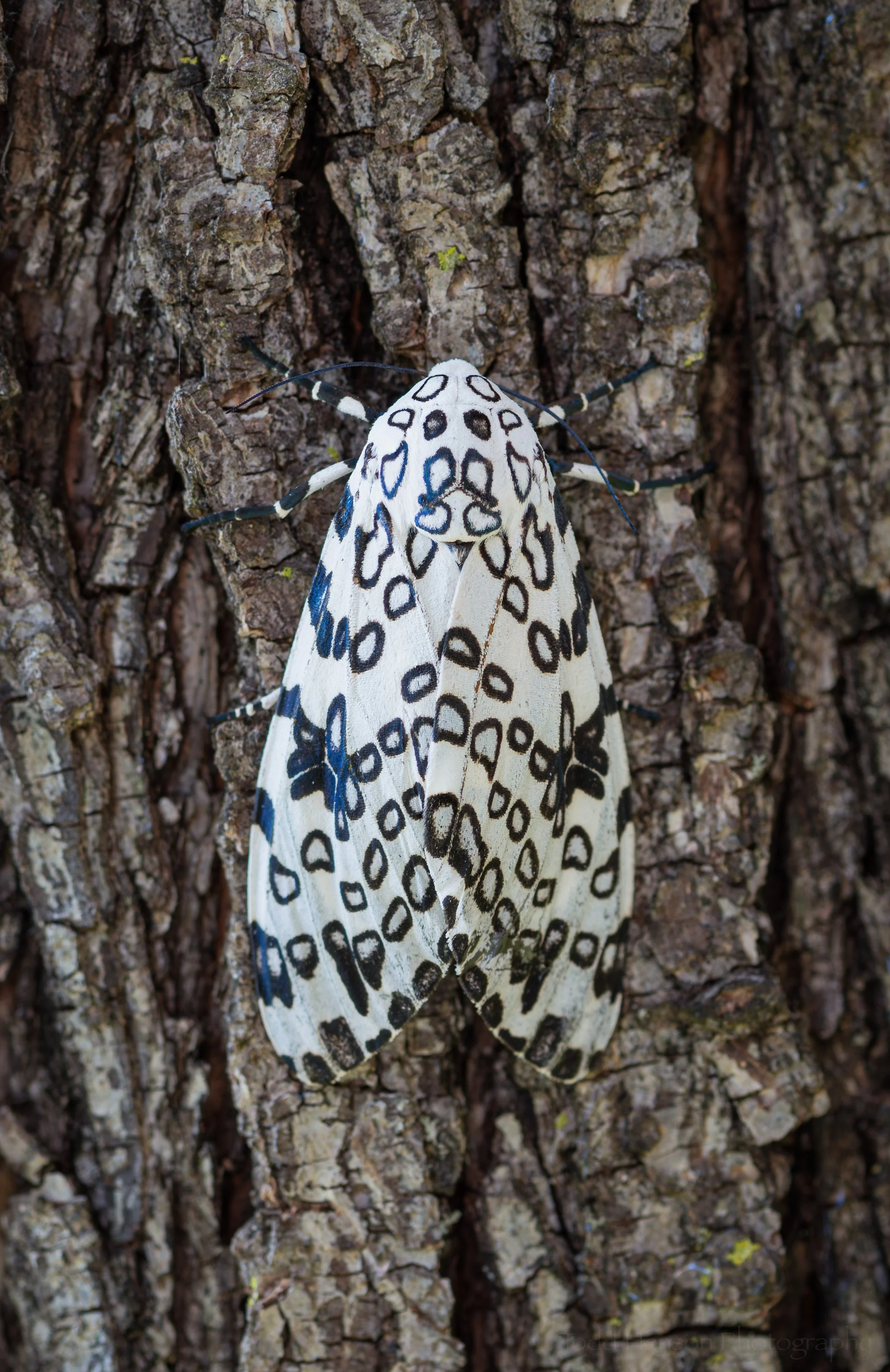
A giant leopard moth on my tree

In early June (2025) I noticed a white spot on the tree in my front yard. Looking closer I found a giant leopard moth resting on the bark, so I grabbed my camera and set about photographing it. I ended up coming back a little later after the sun had moved enough to put the moth into shadow, which helped avoid completely blowing out the white of the moth.

A side view of the giant leopard moth

I wouldn’t really consider the moth a giant, though it was a large one, being perhaps an inch long. After a little research I learned the females grow to about this length while the males can grow to about 2 inches in length. When they fly they have a wingspan of about 3 inches. They’re native to portions of North America.

Face to face with a giant leopard moth

It’s easy to see why they’re called leopard moths because of their spots, both black spots and white ones with a black ring, all set against a white body. It’s a beautiful moth.

Photographing the giant leopard moth from the shadowed side

The next morning the moth was gone, which reinforces what I’d learned about their nocturnal nature and how they avoid flying before nightfall. I never did see this one fly, but I enjoyed photographing it.

An angled view of the giant leopard moth

A couple weeks ago my father and I visited a farmers market in Standardsville, a small town a little west of here, where we saw a booth with photos of several types of moths, one of which was the giant leopard moth. The display was informing people of the problems associated with the very invasion spotted lanternfly and trying to help people learn to identify it. The giant leopard moth and several other species were shown as examples of good species, native to the area, but that are sometimes confused with the lanternfly. It was interesting timing seeing this display as I had so recently seen the leopard moth and was actively working on this post.


Do you enjoy these posts?

Sign up to receive periodic emails with updates and thoughts. Don’t worry, I won’t spam you. And please consider purchasing artwork or products from my online store, and using my affiliate links in the sidebar to the right when shopping online.

I appreciate your support!