Trip Report

10 Maine Lighthouses near Portland and Acadia National Park by Todd Henson

Maine is known for many things, one of which is its lighthouses. I recently visited Maine with my father. We were primarily in the region of Acadia National Park, but also visited the Portland area. I’ve never been all that drawn to lighthouses, but I’ve also not seen all that many. I had planned to photograph both the Portland Head Light and the Bass Harbor Head Light, two of the more well known lighthouses. These are iconic locations, so I figured I’d try to create my own images of them. But the more we saw the more I found myself drawn to lighthouses, and the more we sought them out. In the end I photographed 10 lighthouses along the coast of Maine.

1. Portland Head Light

Portland Head Light, in Maine, with rocky shore and view of Ram Island Ledge Light on an island in the bay

Perhaps the best known lighthouse in Maine is the Portland Head Light, located within Fort Williams State Park in Cape Elizabeth, just south of Portland. The lighthouse is the oldest in Maine and is still in operation. You can watch the light constantly rotate, flashing every few seconds. You can walk up to the lighthouse and the buildings around it, which include a small gift shop. Fort Williams State Park has a number of trails along the coast that give different views of the lighthouse and other sights. Look into the bay and you can also see Ram Island Ledge Light. We were fortunate to have some interesting clouds in the sky during this visit. Other days were completely cloud free.

This photograph of Portland Head Light is available for purchase as wall art or on a variety of products. Additionally, a different view of the lighthouse is available and titled, Keeping Watch.

2. Ram Island Ledge Light

Ram Island Ledge Light, in Maine, with white sailboat in foreground

Ram Island Ledge Light is at the entrance of the Portland Harbor and is visible from Fort Williams State Park and Portland Head Light. It sits on a rocky island in the bay. I was lucky to capture an image of it with a white sailboat passing by in the foreground.

3. Portland Breakwater (Bug) Light

Portland Breakwater (Bug) Light, in South Portland, Maine, with distant view of Fort Gorges to the left in the bay

Portland Breakwater Light, also called Bug Light for its small size, is located on shore at the entrance to Portland Harbor in Bug Light Park, South Portland. It’s at the end of a small rock walkway with a black fence. You can walk right up to and around the lighthouse. There are memorial stones along the length of the walkway. Bug Light is no longer in active use. From Bug Light Park you can see both Fort Gorges in the bay and Spring Point Ledge Light further along the shore.

A black & white version of this photograph of Portland Breakwater Light is available for purchase as wall art or on a variety of products.

4. Spring Point Ledge Light

Spring Point Ledge Light, in South Portland, Maine, with view of Fort Gorges and white sailboat in the bay

Spring Point Ledge Light is very close to Bug Light, near the Southern Maine Community College in South Portland. It is located at the end of a long rocky walkway. You can walk out to and around the lighthouse, though it is not smooth walking, and can be a little nerve racking in a strong wind. I watched as some folks turned around before reaching the lighthouse. We watched people fishing along the rocks at the base of the lighthouse. For the image, I liked how the rocky walkway leads directly to the lighthouse. I waited until the white sailboat was visible and not obscured by the rocks, and made sure Fort Gorges, on the left, was in the frame for a little added interest and context.

A black & white version of this photograph of Spring Point Ledge Light is available for purchase as wall art or on a variety of products.

5 and 6. Cape Elizabeth Light (Two Lights)

The Eastern Tower of Cape Elizabeth Light (Two Lights), in Maine, seen from rocky shore

The Western Tower of Cape Elizabeth Light (Two Lights), in Maine, seen from the grounds of a restaurant

Cape Elizabeth Light is home to two lighthouses known as Two Lights, located in Cape Elizabeth near Two Lights State Park, just south of Portland. The eastern tower is still active, but the western tower is now privately owned. I viewed the western tower from the grounds of a local restaurant, and the eastern tower from the rocky shore just beyond the restaurant. For the eastern tower image, I positioned the yellow foliage between the rocks and the trees to add a little more interest and draw the eye from the rocks up to the lighthouse. For the western tower image I liked the juxtaposition of the lighthouse with the “Thank You Please Come Again” sign from the restaurant.

The photograph of the Eastern Tower of Cape Elizabeth Light is available for purchase as wall art or on a variety of products.

7. Bass Harbor Head Light

Bass Harbor Head Light, in Acadia National Park, Maine

Bass Harbor Head Light is within Acadia National Park on Mount Desert Island not far from the village of Bass Harbor. The lighthouse is still in active use but tourists can walk up to the lighthouse, and along a trail to stairs that head down to the rocky shoreline to get different views. I wasn’t able to get good views from the rocky shoreline this trip. Parking is very limited and this is a popular spot.

8. Egg Rock Light

Egg Rock Light on an island in Frenchman Bay, Maine, viewed from overlook in Acadia National Park

Egg Rock Light is on an island in Frenchman Bay, and has a different look than most of the other lighthouses. The lighthouse, itself, is in a tower within the keeper’s house, so it looks like a large house with the light tower at the top. We viewed the lighthouse from Acadia National Park on a drizzly day. Visibility went in and out as drizzle or fog moved through the area. To get a closer view of the lighthouse I used my 200mm lens with a 2x teleconverter.

9. Winter Harbor Light

Winter Harbor Light, on Mark Island, Maine, seen from rocky coast of the Schoodic Peninsula portion of Acadia National Park

Winter Harbor Light is located on Mark Island, not far from the town of Winter Harbor. It’s visible from several locations along the coast in the Schoodic Peninsula portion of Acadia National Park. Winter Harbor Light is no longer in active use and is privately owned. This view of the island was at quite a distance, so I used my longest lens (400mm) with a 1.4x teleconverter to get in closer.

10. Prospect Harbor Point Light

Prospect Harbor Point Light, Maine, with fishing boats in Inner Harbor, viewed from the shore of Prospect Harbor

Prospect Harbor Point Light is located on Prospect Harbor Point, which is a point that extends into Prospect Harbor, separating Sand Cove from Inner Harbor. It’s no longer possible to visit the grounds of the lighthouse, but it is visible from a couple locations. The photo was taken from across Inner Harbor along the shore of Prospect Harbor. I found a location where I could get down to water level, held the camera close to the water and used a wide aperture to give me a shallow depth of field, blurring out the foreground water. I like the effect this gives.

A black & white version of this photograph of Prospect Harbor Point Light is available for purchase as wall art or on a variety of products. Additionally, a different view of the lighthouse is available and titled, Watching Over Prospect Harbor.


Do you enjoy these posts?

Sign up to receive periodic emails with updates and thoughts. Don’t worry, I won’t spam you. And please consider purchasing artwork or products from my online store, and using my affiliate links in the sidebar to the right when shopping online.

I appreciate your support!


2016 Manassas Airshow by Todd Henson

Yak-52 Flyby. Pilot: Charlie "V+12" VandenBossche.  Camera settings: 400mm, 1/50 sec, f/29

This was my first trip to the Manassas Airshow held May 7 at the Manassas Regional Airport in Manassas, Virginia. My father and I arrived early to make parking easier and to have time to walk around all the static displays before the overhead air show began, which turned out to be around noon. This is a small airport and, consequently, a smaller air show than some venues, but they put on a great show with plenty of variety. The weather was a bit questionable in the beginning, with cloudy skies darkening right over the airport, but it never did rain, and the clouds made for some interesting photos. There were times I wished the sun would have come out a bit more, but at the same time, it beat a cloudless day with a blindingly bright sun. In general, I didn’t have to worry about blowing out highlights.

I haven’t been to many air shows with my camera, so I’m still learning how to photograph them. At my first show I set up the camera as I often do for wildlife, where I usually want the fastest shutter speed I can get with shallow depth of field. So I usually use aperture priority mode with the aperture close to wide open. This worked great with fast moving jets, but I learned it didn’t work well with propeller-based aircraft. Setting the shutter speed too fast freezes the propeller, which looks unnatural. When the aircraft is moving the propeller should be moving, as well.

This year I adjusted settings based on the aircraft overhead. For jets I used my normal aperture priority mode, but for propeller-based aircraft I switched to shutter priority and experimented with shutter speeds. I tried very slow speeds, around 1/50 to 1/60 of a second to try to capture a full rotation of the propeller. This resulted in lots of blurry photos as I had a difficult time panning smoothly enough to freeze the plane, but occasionally I would get a reasonably in focus aircraft with a nicely blurred propeller. Sometimes I increased the shutter speed to over 1/200 of a second. This helped me capture a few more aircraft in focus and usually still captured some propeller motion, though not a full rotation of the propeller. I really enjoyed the experimentation, and I look forward to future shows so I can get more practice.

One of the early performers was Charlie “V+12” VandenBossche flying his Yak-52, so right away I was practicing slower shutter speeds. I love when these planes turn on their smoke trails, it can really help make some dynamic photos.

Yak-52 Descent. Pilot: Charlie "V+12" VandenBossche. Camera settings: 360mm, 1/60 sec, f/45

Yak-52 in Flight. Pilot: Charlie "V+12" VandenBossche. Camera settings: 400mm, 1/80 sec, f/29

Next up was The Flying Circus, out of Bealeton, Virginia. They had a wing walker climbing all over the wings of the bi-plane. These guys were amazing. You can tell they do this all the time. Great stuff.

The Flying Circus Superhero. Pilot: Chuck Tippett. Wing Walker: Joe Bender. Camera settings: 400mm, 1/50 sec, f/29

Hanging On. Pilot: Chuck Tippett. Wing Walker: Joe Bender. Camera settings: 400mm, 1/80 sec, f/20

Scott Francis had some amazing moves in his MXS aircraft. It’s a beautiful little plane and he really knows how to push it. I increased the shutter speed here to freeze the aircraft. You can see the propeller is blurred but it doesn’t show a full rotation.

Scott Francis in his MXS. Camera settings: 400mm, 1/320 sec, f/5.6

A little later the Warrior Flight Team took to the air in a pair of L-39 Albatross. These two were great, performing a number of synchronized maneuvers.

A Pair of Albatross. The Warrior Flight Team. Camera settings: 165mm, 1/800 sec, f/5.6

One of my favorite aircraft at the show was Greg Colyer’s T-33 Shooting Star, named Ace Maker II. There was just something about both the look and moves of this aircraft. Lots of fun to watch and photograph.

Top View of the Ace Maker II. Pilot: Grey Coyler. Camera settings: 370mm, 1/2000 sec, f/5.6

Ace Maker II Flyby. Pilot: Grey Coyler. Camera settings: 400mm, 1/1600 sec, f/6.3

Finally, the last aircraft I photographed was the Sea Harrier flown by Art Nalls. This is the first, and at present only, privately owned and flown Harrier, so it was great getting the opportunity to see it in action. I have seen Harriers at air shows before, and they are always a marvel to watch. It’s amazing how little runway is needed to get one of these off the ground. One of the popular moves is towards the end of the performance when they turn the aircraft facing the audience, hover in place, then slowly take a bow with the aircraft. Amazing control! And, of course, there is the vertical landing that only something like the Harrier can perform.

Harrier Bowing to Audience. Pilot: Art Nalls. Camera settings: 400mm, 1/2000 sec, f/6.3

Harrier Vertical Landing. Pilot: Art Nalls. Camera settings: 400mm, 1/1000 sec, f/6.3

The Manassas Airshow was a lot of fun. I’m happy my father and I were able to spend part of the day here. It was well worth it. If you’ve never been to an air show go check one out.


Do you enjoy these posts?

Sign up to receive periodic emails with updates and thoughts. Don’t worry, I won’t spam you. And please consider purchasing artwork or products from my online store, and using my affiliate links in the sidebar to the right when shopping online.

I appreciate your support!


Washington, D.C. Cherry Blossoms - 2016 by Todd Henson

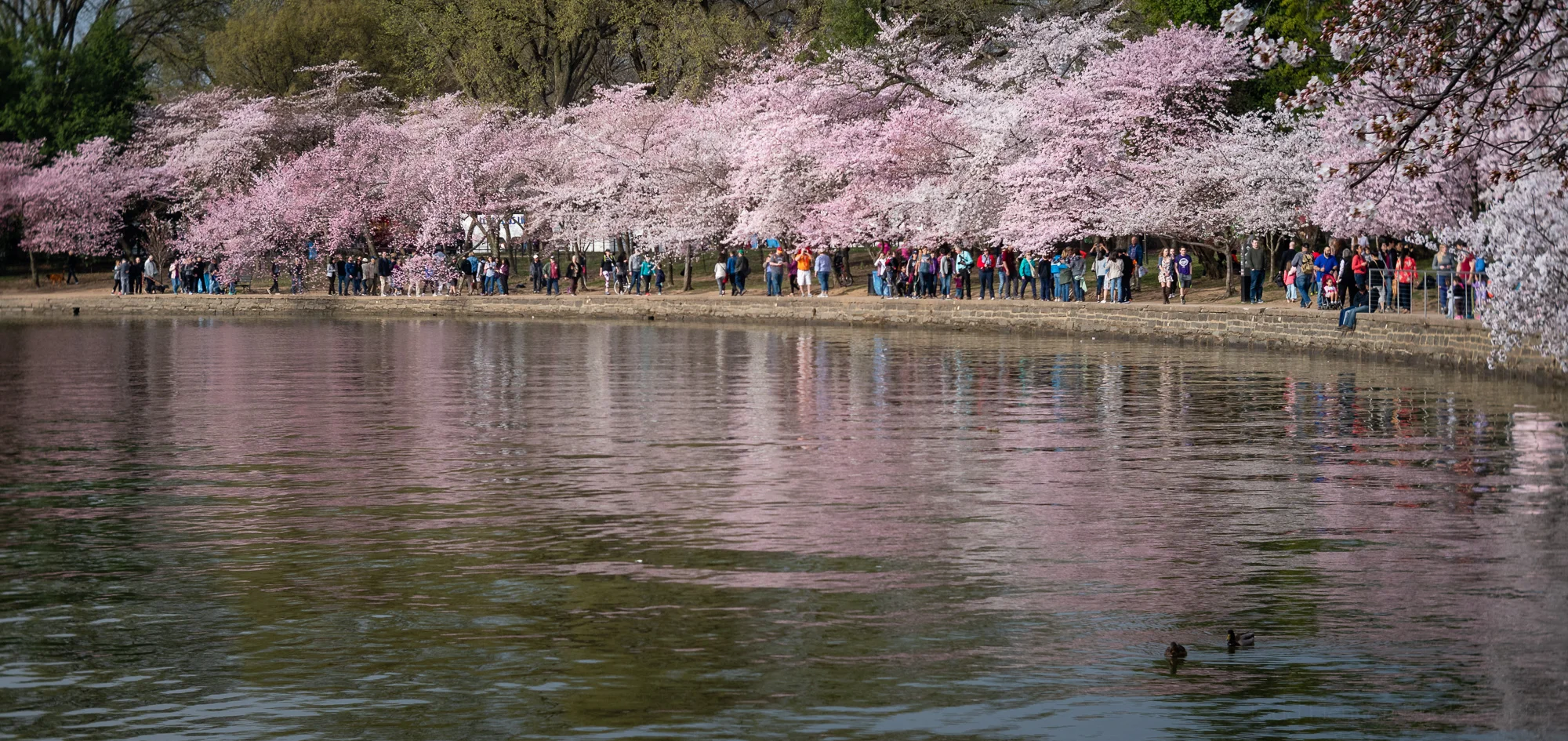
Cherry trees along the tidal basin in Washington, D.C.

The Washington, D.C. tidal basin and surrounding areas are home to thousands of cherry trees that bloom each spring. During this time D.C. hosts the Cherry Blossom Festival, Sakura Matsuri Japanese Street Festival, Blossom Kite Festival, and many other events with ties to Japanese culture. This time also draws large crowds of people to the tidal basin to see the cherry blossoms in bloom. It really is a beautiful sight and well worth the trip. For smaller crowds I prefer to visit on a week day, but sometimes the timing doesn’t work out and it has to be on a weekend. This year my brother and I visited on a Saturday very close to peak bloom, and as expected there were large crowds all around the tidal basin.

Swan boat in the tidal basin, Washington, D.C., cherry blossoms in the background

From a photographic perspective, I find myself most inspired when alone or in smaller groups. I have a more difficult time making images around large crowds of people, so this trip was a challenge for me. One thing I often don’t do much of, but would like to try more in the future, is incorporating the crowds of people into more photos. I most often look for quieter scenes, waiting for a clearing in the people, but sometimes the people can really add to the shot.

Martin Luther King, Jr. Memorial from a distance, surrounded by cherry blossoms.

Kayaker, and photographer, in Potomac River just outside tidal basin, cherry tree in the background.

One of the newer additions to the tidal basin is the Martin Luther King, Jr. Memorial. In previous years I had tried to capture the main portion of the memorial by itself, but this year I tried to incorporate other elements, such as the cherry blossoms. While walking around the memorial I noticed you can line it up with the Washington Monument, which was nice. I would like to try this again with different weather. The day we were there the sun was very bright and the sky cloudless. This creates very high contrast scenes, which can sometimes be nice, but I’d also like to try making some images in softer light.

Martin Luther King, Jr. Memorial surrounded by cherry blossoms.

Black and white photo of Martin Luther King, Jr. Memorial and Washington Monument.

Further along the tidal basin is the Franklin Delano Roosevelt Memorial, which is full of statues, murals, waterfalls, and carvings. There’s a lot to see in this memorial. It’s well laid out, with various sections separated by walls with walkways between them. It can feel like walking through a museum of memorials.

Black and white photo of statue in Franklin Delano Roosevelt Memorial.

Black and white photo of statue of Eleanor Roosevelt in Franklin Delano Roosevelt Memorial.

Black and white photo of statue of Franklin Delano Roosevelt and his dog in Franklin Delano Roosevelt Memorial.

It’s not uncommon to stumble across photo shoots of various sorts, from portraits to weddings, and sometimes people dressed in more traditional Japanese fashion. Some of the photo shoots can be bigger productions with multiple people, light stands and reflectors, whereas others are just a single photographer and a single model.

Woman posing for a photo shoot at the Franklin Delano Roosevelt Memorial.

Woman posing for a photo beside the Japanese Pagoda.

People also love to pose in front of the various monuments, memorials and statues. It’s fun to stand back and watch as one person after another poses in the same spot.

Black and white photo of the Thomas Jefferson Memorial.

Another very popular spot along the tidal basin is the Thomas Jefferson Memorial. It’s a beautiful building that stands right along the tidal basin, with steps leading up to the memorial. People gather on the steps in large numbers. Sometimes tents are set up for events along the water, but not this day. I’ve always enjoyed making images of the statue of Jefferson in silhouette. Sometimes I can get just the statue, other times it’s full of people.

And, of course, there are the cherry blossoms, themselves. Japan gifted thousands of cherry trees to D.C. in 1912, which eventually led to the annual Cherry Blossom Festival and all the other fascinating events surrounding it. Over the years I’ve enjoyed traveling to D.C. to see the cherry trees. Some years we’re early and see mostly buds, other years we’re late and see mostly falling petals. This year we visited very close to peak bloom. I look forward to seeing what next year brings.

Cherry blossoms along the tidal basin in Washington, D.C.


Do you enjoy these posts?

Sign up to receive periodic emails with updates and thoughts. Don’t worry, I won’t spam you. And please consider purchasing artwork or products from my online store, and using my affiliate links in the sidebar to the right when shopping online.

I appreciate your support!