A Scintillating Spider Web by Todd Henson

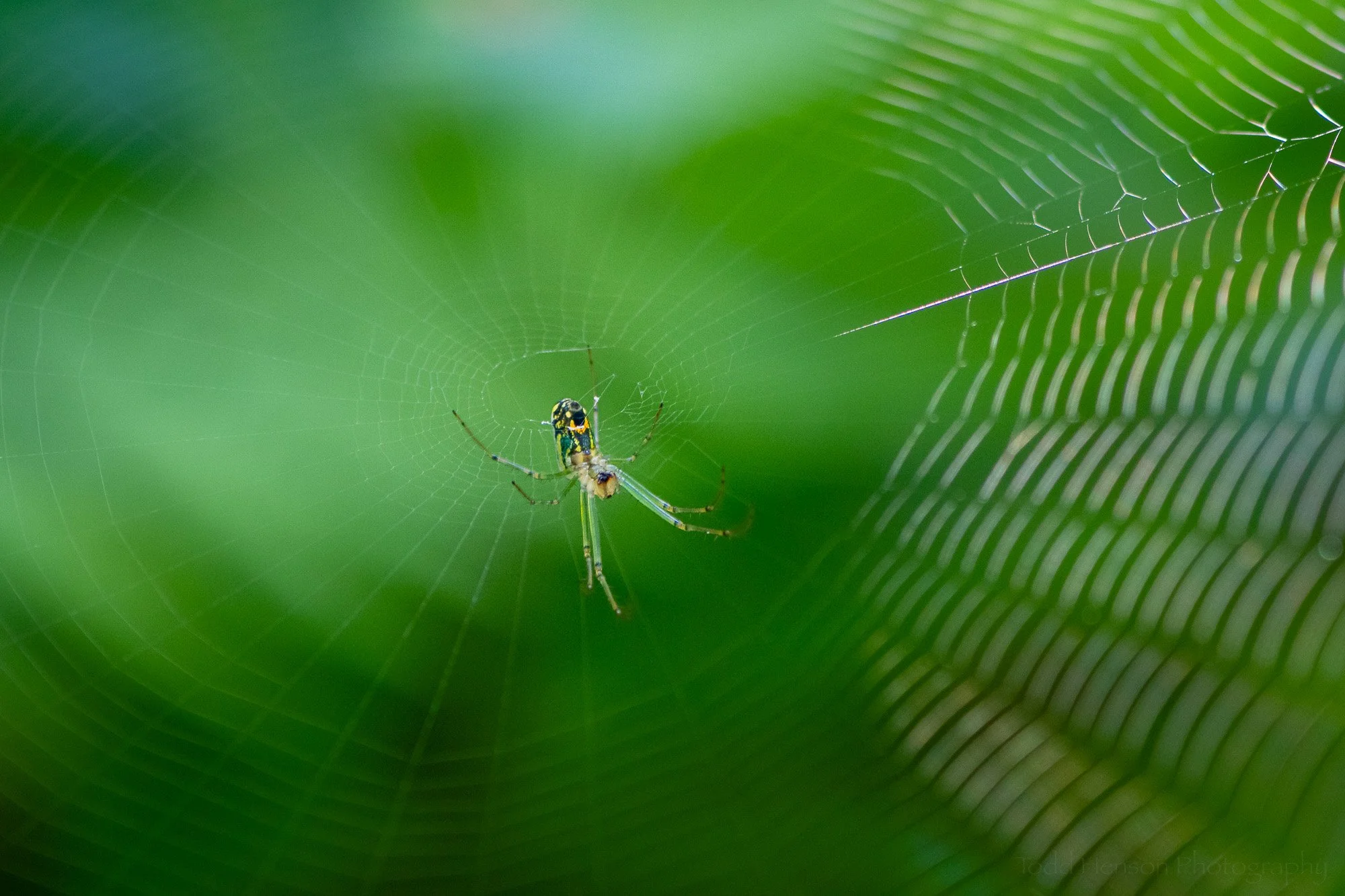
A scintillating spider web

Light is everything in photography. Without it we wouldn’t have photography. So I watch for changing light and how this affects the scene in front of me. And sometimes I’m amazed by what light and nature create.

My father and I were hiking the Oak Ridge Trail in Prince William Forest Park one morning. As is often the case on these hikes, I wasn’t looking for anything specific to photograph, but instead remaining open to anything we stumbled across. I often travel with just a single lens which limits what I’m able to capture, but that sort of constraint can sometimes be a good thing (as is the lower weight and bulk of my pack!). On this morning I was carrying my 105mm macro lens, so naturally I was drawn to smaller subjects.

One thing that’s hard to overlook during early morning hikes are all the various spider webs (sometimes crossing right over the trail, so watch out!). It really is amazing just how many spiders are out there. We saw so many webs, each different, and from a wide variety of spider species.

Then we rounded a corner and noticed how the light was hitting this one special web, creating such beautiful scintillations, colors and shapes just twinkling and sparkling. It was like looking through one of those old kaleidoscopic tubes, twisting it and watching the colors and shapes swirling and changing.

I quickly pulled up my camera and tried to capture some of this incredible sight. I was hand-holding and it was early enough that this part of the forest was still fairly shaded. Thankfully there wasn’t a lot of wind, so the spider and its web weren’t moving too much, but I still needed to raise the ISO to between 1000 - 1600 to give me a shutter speed of between 1/80 to 1/320 of a second. I have a bit of a shake to my arms so it wasn’t a perfect situation and using a tripod would have been better, but sometimes there’s more benefit to the flexibility of not using a tripod.

Spider glow

A couple minutes later the scene had completely changed, all because of the shifting light. I continued photographing the same spider, which I believe to be a filmy dome spider. This time, though, the light was enough to light up just the spider, letting all else fade to black, the web almost invisible, the spider appearing to glow. It makes for a very different image, doesn’t it?

Clinging to the web

About a minute and a half later, and from a slightly different perspective, I created this final image. This time we can see the web, but with a very different look than the first image. In this one it’s far more simple, a multitude of little threads. I liked how you can see where the spider’s legs touch the web and how they sometimes pull on it just a little. Notice how different the spider looks in this light, too. You get a more detailed view of it, helping with identification.

Any light can be good light for photography. You just need to be open to the possibilities and willing to experiment. Always be aware of the light around you. It can shift and change in so many ways as the sun travels across the sky, clouds move in and out, trees sway back and forth. Spend some time in one location and notice how the light can change and how this affects the scene.

It’s a beautiful world out there!


Do you enjoy these posts?

Sign up to receive periodic emails with updates and thoughts. Don’t worry, I won’t spam you. And please consider purchasing artwork or products from my online store, and using my affiliate links in the sidebar to the right when shopping online.

I appreciate your support!

Broad-headed Sharpshooter (Oncometopia orbona) by Todd Henson

A broad-headed sharpshooter (Oncometopia orbona) resting on a leaf

Today we take a brief look at a very interesting looking insect, one that’s not uncommon but that many of us may not have seen before. This is a broad-headed sharpshooter (Oncometopia orbona), a type of sharpshooter and in the family of leafhoppers. As you may be able to tell from the names these insects are able to hop or shoot quickly away from a plant. They also typically feed on plants, essentially drinking liquid from them. Unfortunately, this particular species is also known to carry a bacterium that causes disease in grapevines in some regions.

This particular sharpshooter was photographed at the end of July, 2021, at Blandy Experimental Farm, the State Arboretum of Virginia, a fantastic location for lovers of plants and all the things you can find around plants. There were large fields of plants and that’s where I happened to notice the interesting coloration and patterns of this insect.

Cropped in to get you a little closer to the broad-headed sharpshooter

Look closely and you may notice an interesting feature of this specific insect. I believe this is a female broad-headed sharpshooter. How can I tell? The females can sometimes be seen with white milky or waxy patches on the sides of their wings. The patches are called brachysomes and contain proteins they’ll scrape onto their eggs to help protect them from drying out and from some predators. I think the small patches of white on the wings and the rear legs of this sharpshooter might be the remains of this substance, so she may have recently laid some eggs somewhere.

In the past I’ve shared photos of another sharpshooter, a Versute sharpshooter on the leaves of an hibiscus.

Have you seen one of these broad-headed sharpshooters before? And if so, where did you find it?


Do you enjoy these posts?

Sign up to receive periodic emails with updates and thoughts. Don’t worry, I won’t spam you. And please consider purchasing artwork or products from my online store, and using my affiliate links in the sidebar to the right when shopping online.

I appreciate your support!


Snowberry Clearwing Moth by Todd Henson

Snowberry clearwing moth on thistle

In a recent post about the hummingbird clearwing (Hemaris thysbe) I’d mentioned that it wasn’t the only clearwing moth in the area, so today we take a look at another, the snowberry clearwing (Hemaris diffinis). Both of these species are known as hummingbird moths for their resemblance to hummingbirds. If you don’t look closely, or aren’t aware of their existence, it can be easy to confuse one for the other.

Looking at the back of a snowberry clearwing feeding on thistle nectar

The primary differences between the snowberry and the hummingbird clearwing, as mentioned in the previous post, are the black legs on the snowberry (versus pale colored on the hummingbird) and the dark band around the eyes and down the side of the snowberry. Both can have an olive-greenish toned thorax, but as you can see, one of these snowberry has less green in it, instead featuring a more tan or golden thorax. There is some variation in each species appearance.

The benefits of a long tongue become obvious when watching this snowberry clearwing feeding

Some of these photos are not as in focus as I’d like. These little hummingbird moths are quite challenging to photograph as they constantly move about from flower to flower, feeding on nectar. But I’m hopeful the photos help show just how much of the wing can be clear, hence the clearwing in their name.

In this photo the snowberry clearwing has just finished feeding and is moving away from the flower. Notice how its tongue begins to curl inwards.

The other feature I’d like you to notice is their long tongue, used to reach into deeper flowers much as hummingbirds do. As the snowberry clearwing moved away from a flower it had just been feeding from it curled up its tongue. I don’t know if this is typical behavior, though I suspect it is.

The snowberry clearwing has moved further from the flower after feeding and we can now see its tongue more tightly curled.

If you happen to live in the eastern half of the United States then keep your eyes open for snowberry clearwing hummingbird moths. You just might see one. I don’t see them all that often, but each time is a joy. I hope you’ve gotten some enjoyment viewing these wonderful little flying marvels.


Do you enjoy these posts?

Sign up to receive periodic emails with updates and thoughts. Don’t worry, I won’t spam you. And please consider purchasing artwork or products from my online store, and using my affiliate links in the sidebar to the right when shopping online.

I appreciate your support!