Techniques

Approaching a Small Toad by Todd Henson

How do you approach a small animal, like this little toad?

Approaching a small, skittish animal requires patience. I start photographing further away just to assure I get a shot. And don’t forget creating wide angle images of wildlife in the landscape can be just as appealing as close-up portraits. But today we’re talking about trying to get closer for that nice portrait shot.

First you have to assess whether it’s even safe to consider moving closer. You don’t want to risk the welfare of either the wildlife or yourself. In the example today, of this small toad, there weren’t any major concerns.

Approaching wildlife is most often a very slow process.

Small subjects can easily be frightened by us as we’re so much larger than they. So it can sometimes help to get as close to eye-level with them as possible. Granted, you’ll never be able to be at the same level as this little toad, but you can get down on the ground, lying flat if you can, to lessen your profile and appear smaller than you are.

It’s often recommended you don’t make eye contact with wildlife as that can spook them or cause them to become aggressive, seeing it as a challenge. I don’t know if that applies to small amphibians. 😃

Make small moves and move slowly and quietly.

The key to getting close is to move slowly and quietly. The hope is the animal will almost get used to us, seeing us as just another part of the background, not a threat. You can see in the sequence of images of the toad I very slowly moved closer, and each time I repositioned I created an image. I was using a fixed focal length lens (105mm) so there was no zooming with the lens. If I wanted a closer portrait I needed to get physically closer to the toad.

Pause every so often to help let the creature get used to you.

And you will discover there’s always a hidden line the subject will consider too close. If you cross that line the subject will move away (or worse if it’s a predator, which I wouldn’t recommend approaching anyway). Where that line is will vary from species to species and even animal to animal. I try very hard not to cross that line as that most often means the end of my opportunity to photograph that subject. But in the case of this little toad I knew it was very likely at some point it would begin hopping away. So until then I did the best I could to capture closeups.

With a little luck, patience and practice you’ll get close enough for a nice close-up portrait.

Eventually, the toad had enough of me and began hopping away. I was able to capture one more image of it after the first hop. I liked how it had landed with its rear leg and foot raised just a bit sitting on a leaf. After creating this image I slowly backed off and left the little toad in peace.

One final view of the toad before leaving it in peace.

Just a quick technical note, for those interested. This was early enough in the morning and under enough tree cover to be fairly dark. I was hand holding the camera, helping me stay nimble and presenting less visible bulk in view of the toad. To get a shutter speed fast enough to avoid most blur I had to boost the ISO to 4000. This means there is some level of noise in these photos, especially in the darker portions. But I thought getting the shots was worth the potential noise, and it was also a fun exercise in approaching a small animal.


Do you enjoy these posts?

Sign up to receive periodic emails with updates and thoughts. Don’t worry, I won’t spam you. And please consider purchasing artwork or products from my online store, and using my affiliate links in the sidebar to the right when shopping online.

I appreciate your support!
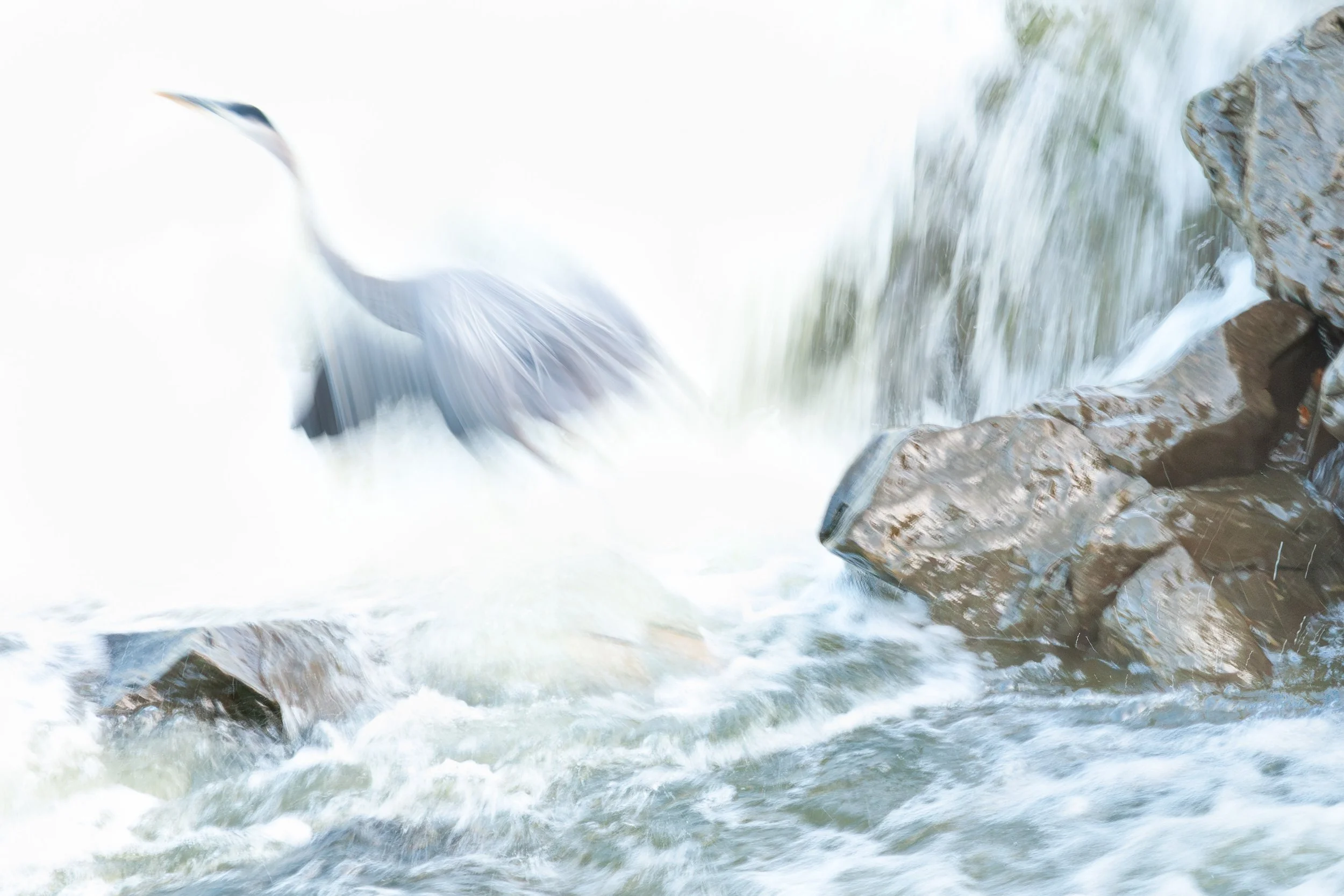

10x10 Exercise - Reflections of Early Spring by Todd Henson

I recently listened to an episode of Daniel Gregory’s The Perceptive Photographer Podcast, one of several I enjoy. In it he mentioned a creativity exercise he uses to help us learn more about our work, about patterns and habits we might fall into, and about discovering new ways of seeing and approaching our work.

For a 10x10 exercise you take 10 of your images and edit them in 10 different ways, resulting in 100 different images. He figures over this body of work you can begin to see default editing patterns you fall into, ways you often approach your images. And it also might help you discover other ways of looking at the work, trying things you might not have thought to otherwise try.

So I decided to give the exercise a go, and here are the results of the first image I worked on.

Version 1

Reflections of Early Spring - Version 1

This is a fairly straight forward edit, very close to what I saw in late March of this year.

Version 2

Reflections of Early Spring - Version 2

With this version I went for a softer feel with less color, but focusing on some of the muted colors in the center.

Version 3

Reflections of Early Spring - Version 3

Continuing with the softer feel of the previous version I softened it up a bit more around the edges and took out some of the color, especially the blues.

Version 4

Reflections of Early Spring - Version 4

This time I thought of trying a split toned monochromatic image to give an older feel.

Version 5

Reflections of Early Spring - Version 5

And another split toned monochromatic but shifting more towards the blues.

Version 6

Reflections of Early Spring - Version 6

And pulling out all color we get a black and white image.

Version 7

Reflections of Early Spring - Version 7

Given the reflections I thought it might be interesting seeing how it looked inverted, so I flipped it along the horizon putting the reflections up top and the sky down below.

Version 8

Reflections of Early Spring - Version 8

An obvious choice was turning the horizontal image into a vertical.

Version 9

Reflections of Early Spring - Version 9

I felt like I was running out of ideas, so for this image I zoomed in to focus just on the central part.

Version 10

Reflections of Early Spring - Version 10

For the final image I took inspiration from a great book cover for The Children of Red Peak by Craig DiLouis, a book I’ve not read but one whose cover I really like. Similar to a previous image, I flipped it, putting the sky down below, but I also cropped it to focus on a specific section.

Thoughts

It might be too soon to draw many conclusions or lessons from this exercise since I’ve only performed it on one image so far. But I did see how it can be a challenge to find new ways of processing an image. I think I often see an image a specific way and have to really put in effort to see it in other ways. I did enjoy this process, though. I can see how this exercise could help us creatively, letting us see more potential in a scene. And though this was focusing on processing an image, I think in doing so it could help us see differently when in the field if we’re more open to the later possibilities of what we’re capturing.

And I think this exercise could be applied to other art forms, at least to some extent. If you’re a musician try writing 10 variations of a song. If you’re a sculptor try 10 different versions of the same basic figure. If you’re a writer try 10 different variations of a story or a scene in a story.

What do you think? Did you prefer any of these images over the others? Is this an exercise you might try?


Do you enjoy these posts?

Sign up to receive periodic emails with updates and thoughts. Don’t worry, I won’t spam you. And please consider purchasing artwork or products from my online store, and using my affiliate links in the sidebar to the right when shopping online.

I appreciate your support!
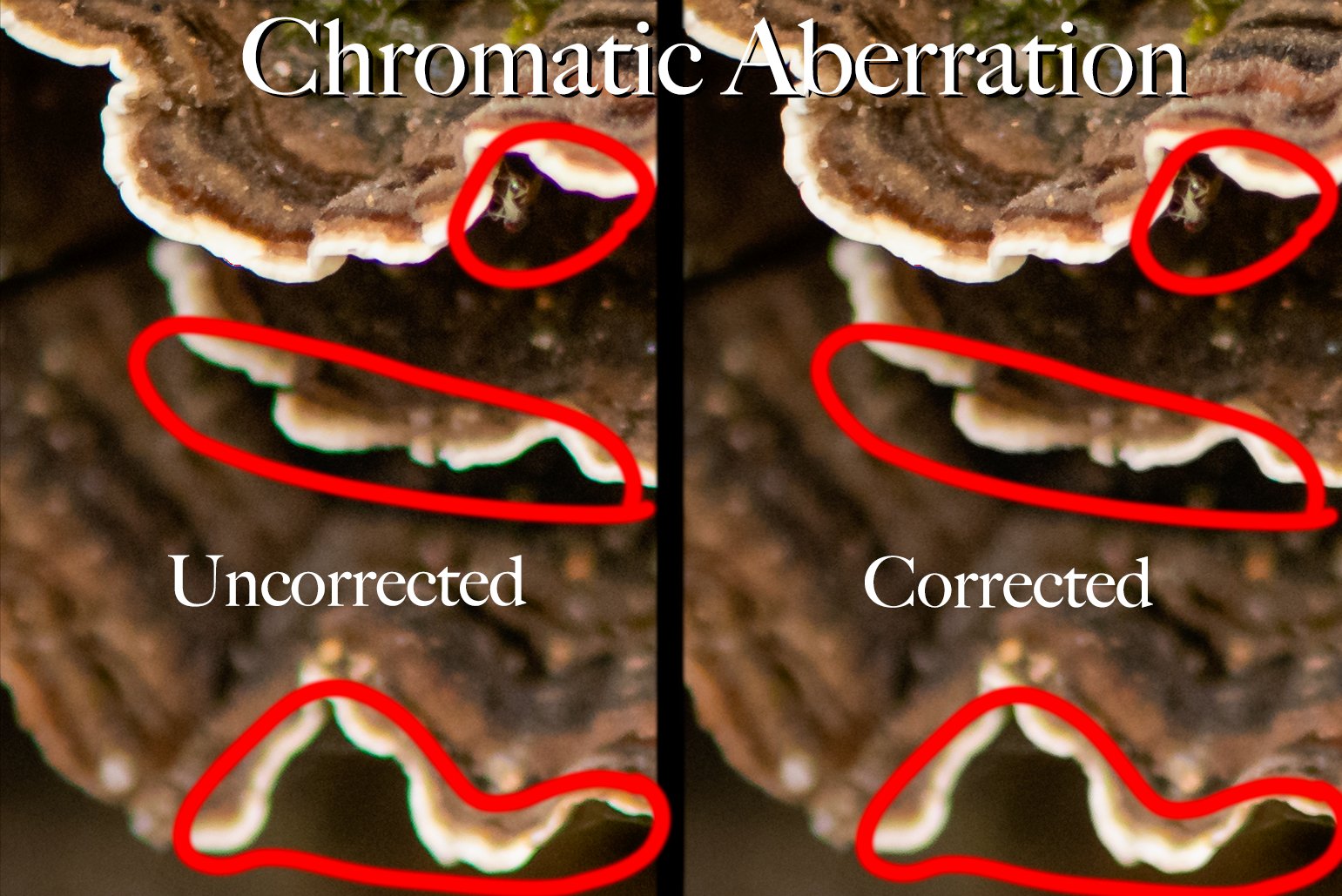

An Example of Working the Scene at Brookside Gardens by Todd Henson

My first photo was an establishing shot of an interesting scene.

I have seen some folks arrive at a scene, look around, bring their camera to their eye and take a single shot, then move on. Perhaps they are just masters at what they do and are able to find and capture the perfect photo in one go. Maybe they’re short on time. Or perhaps they just haven’t learned the benefits of taking the time to work a scene.

I will admit, I don’t always take the time needed to fully explore a scene. Sometimes I don’t even partially explore a scene. But I do try to remind myself to slow down, to look around, to see the scene from different perspectives and different angles, to try getting closer to the subject or further away, to explore the possibility of alternate subjects.

Today’s photos are an example of this, of working the scene while walking through the beautiful paths of Brookside Gardens in Wheaton, Maryland. It’s such a wonderful location with an endless array of potential subjects and scenes worth photographing. In this particular case I found a portion of the path that caught my eye, how it moved through the gardens, the different colors and textures, the wooden structure in the background. So my first photograph was an establishing shot of the entire scene.

Then I zoomed in a little closer, winnowing down the elements of the scene, focusing attention a little more in one direction. You can do this using a zoom lens or you can physically move yourself around to find different perspectives, to search out the portion of the scene you find most compelling.

I zoomed in a bit, narrowing in on a smaller portion of the scene.

Continuing this further I found myself photographing a small section of the plant life, with a cactus to the right and some flowers down the center with the bottom covered in light green plants.

Continuing this I started finding details, smaller sections of the gardens I found appealing.

And finally, I turned the camera and created a vertical photograph of the scene with the cactus towards the bottom and the field of flowers going out of focus and stretching to the top of the frame.

I kept refining my view of the scene, working the scene.

Did the photos get better as I worked the scene? Not necessarily. But they did change. They gave me new views of the scene. They let me explore it in different ways. And if I’d spent a little more time there I likely could have found more compositions, perhaps some I would have preferred over these.

So next time you’re out with your camera and find something interesting to photograph, try to slow down, to look around. Take the time to work the scene. You may be pleasantly surprised by what you discover.


Do you enjoy these posts?

Sign up to receive periodic emails with updates and thoughts. Don’t worry, I won’t spam you. And please consider purchasing artwork or products from my online store, and using my affiliate links in the sidebar to the right when shopping online.

I appreciate your support!