Field Notes Update

Hummingbird Clearwing Moth by Todd Henson

A hummingbird clearwing moth (Hemaris thysbe) hovering by a flower

I still remember the first time I saw a hummingbird moth and learned it was an insect and not a bird. Similar to how a hummingbird has a small body for a bird, a hummingbird moth has a large body for a moth. And so the two end up very similar in size, flying in somewhat similar ways, both making similar sounds, and feeding around similar plants. It’s no wonder then, is it, that we mistake them? And yet, they are so very different.

The hummingbird moth we’re looking at today is called a hummingbird clearwing (Hemaris thysbe). It’s not the only clearwing in this area and looks very similar to the Snowberry clearwing (Hemaris diffinis). But the hummingbird clearwing has more red on its wings and lower body, and its legs are pale colored. The Snowberry clearwing has black legs, and also a dark band around its eyes and across its sides. They both can have a greenish toned thorax and a darker abdomen which almost appear to be covered in fur, contributing to their resemblance to hummingbirds.

A hummingbird clearwing moth (Hemaris thysbe) gathering nectar from flowers

These moths are wonderful flyers and a joy to watch as they flit from flower to flower feeding on the nectar. They have an extraordinarily long tongue that lets them feed from flowers some insects are unable to. But the flowers in these photos, which I believe are beebalm, don’t present much challenge to hummingbird moths or other insects.

Trying to photograph hummingbird moths can be a real challenge as they’re fast movers, and their wings are almost never still. I do wonder what they’d look like if they ever landed to rest, but I’ve only ever seen them in flight. I was fortunate to capture a couple nice views, showing details on their back, sides and wings. Look closely and you can see the clear portions of their wings that explain the clearwing part of their name. You can also see the long tongue extended into the flower.

Have you ever encountered hummingbird moths? Are they common in your area?


Do you enjoy these posts?

Sign up to receive periodic emails with updates and thoughts. Don’t worry, I won’t spam you. And please consider purchasing artwork or products from my online store, and using my affiliate links in the sidebar to the right when shopping online.

I appreciate your support!

Cardinals Nesting in the Blueberries by Todd Henson

Male northern cardinal and blueberries

My folks have several blueberry bushes that some years provide great tasting blueberries and other years are almost completely eaten by wildlife before they’re fully ripe. The best blueberry years are those when there’s netting over the bushes, but sometimes there’s just not enough time to deal with new netting. This year we were trying to put up some make-shift netting, hoping to get some berries, when my father discovered a nest in one of the bushes, which turned out to be the nest of a pair of northern cardinals. And it contained at least three small blue eggs with brown spots, so it was an active nest. Pretty exciting, but also a little disappointing, as we wouldn’t be able to put up netting on that particular bush.

Northern cardinal eggs in a nest

While working around the bushes I took the opportunity to briefly photograph the nest and the eggs, as I’d never seen an active cardinal nest before. But I tried, as much as possible, to stay away from the nest, both so I didn’t disturb it and so I didn’t attract attention to it.

Female northern cardinal reaching for blueberries

Later, after we were finished with the netting, I setup at a distance and photographed some of the activity in the blueberry bushes. Many of the local birds are somewhat used to the presence of people, which makes photographing them much easier. And most years my folks have bird feeders, though this year they don’t as local authorities have recommended taking down all bird feeders because of a bird illness sweeping through the region that they think might be spread faster when birds congregate at feeders. Thankfully, I didn’t see evidence of this illness with these birds.

The female northern cardinal flying between branches

Mmmm, mmmm good! The female northern cardinal feasting on a blueberry

But being used to people, and having such a great food source as a blueberry bush with ripening berries, it was fairly easy to get some interesting photographs of the pair of cardinals. I setup at a bit of a distance from the bushes, right between some raised garden beds where my folks grow vegetables. I watched as the male cardinal sometimes turned to look at me as he heard the camera’s shutter click. And I watched as the female pulled down and ate several blueberries.

Though somewhat exposed up top, from the side the female northern cardinal is difficult to see in her nest

If you’re curious how to tell the male and female apart, look closely at the coloration. The male is a brighter red, whereas the female has some reddish tones to her feathers but is otherwise a duller color, more tan or brown. The dark feathers around the beak of the male are black, but on the female they are closer to gray.

Are you still there? One final look at the male northern cardinal peeking around some branches at me

We were hopeful this might turn into a productive nest but also concerned the cardinals had chosen a poor location. The nest was somewhat exposed up top. And the blueberry bushes, though containing plenty of food for the cardinals, also attracted many other birds and critters. I don’t know that building a nest right in the middle of a local food source for other animals was a good idea. Unfortunately, this did prove true, as several days later my father found the nest empty. I’m hopeful this was early enough in the season that the pair of cardinals found a better location to try again and that perhaps this story, even with the initial losses, had a happy ending.


Do you enjoy these posts?

Sign up to receive periodic emails with updates and thoughts. Don’t worry, I won’t spam you. And please consider purchasing artwork or products from my online store, and using my affiliate links in the sidebar to the right when shopping online.

I appreciate your support!

Sheltered Gray Treefrog by Todd Henson

Sheltered: A large gray treefrog resting on the rail

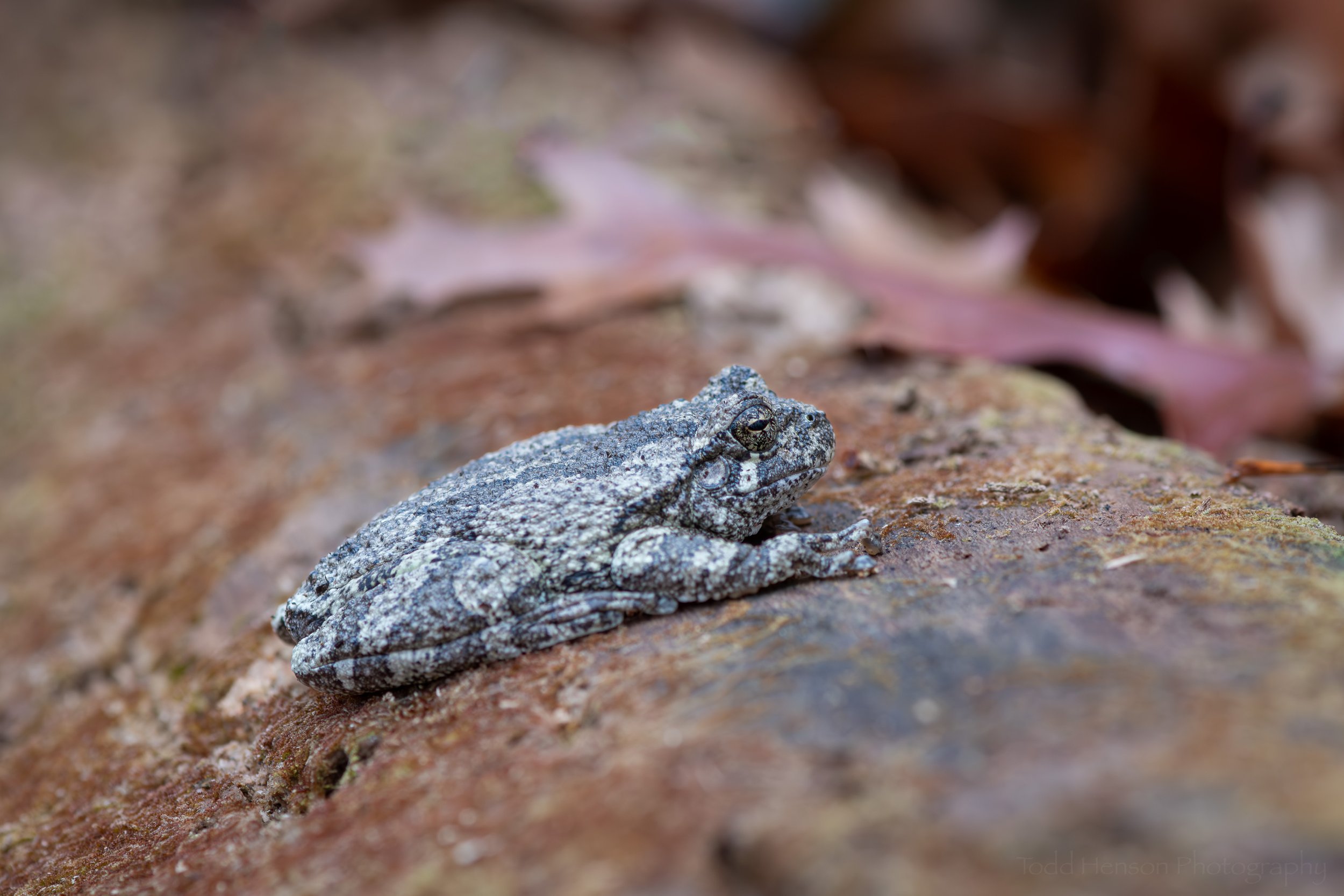
My neighborhood isn’t the sort of place I expect to find wildlife, and yet I do continue to find it in small numbers and especially in small forms. One that I’ve seen and photographed a few times now are small gray treefrogs, which seem to like my steps and railing.

Let Me Sleep!

I found this particular frog in the early afternoon one Sunday as I was heading out the door. Out of the corner of my eye I happened to see a shape I wasn’t used to seeing on the end of the railing at the base of my front steps and did a double take when I noticed this good sized gray tree frog sheltered in curve of the metal raining, sleeping off the day and waiting for night to head back out and about. The way the sun sets it picked a perfect position to shelter its eyes from much of the light. I had to bring up the shadows a fair bit in post-production to let you see its eyes.

Gray treefrog closeup

As you can see, its eyes were open, so it was aware I was there, but it didn’t see me as a threat and just remained resting as I slowly moved closer creating photos. The last photo gives a decent view of one of this frog’s eyes. Look at the interesting patterns there, and the little bits of color, like the orange in the eye and the green just below it. I never get tired of viewing these amazing little creatures.

For more, check out the two previous posts where I had encounters with gray treefrogs at the front of my house:


Do you enjoy these posts?

Sign up to receive periodic emails with updates and thoughts. Don’t worry, I won’t spam you. And please consider purchasing artwork or products from my online store, and using my affiliate links in the sidebar to the right when shopping online.

I appreciate your support!