Field Notes Update

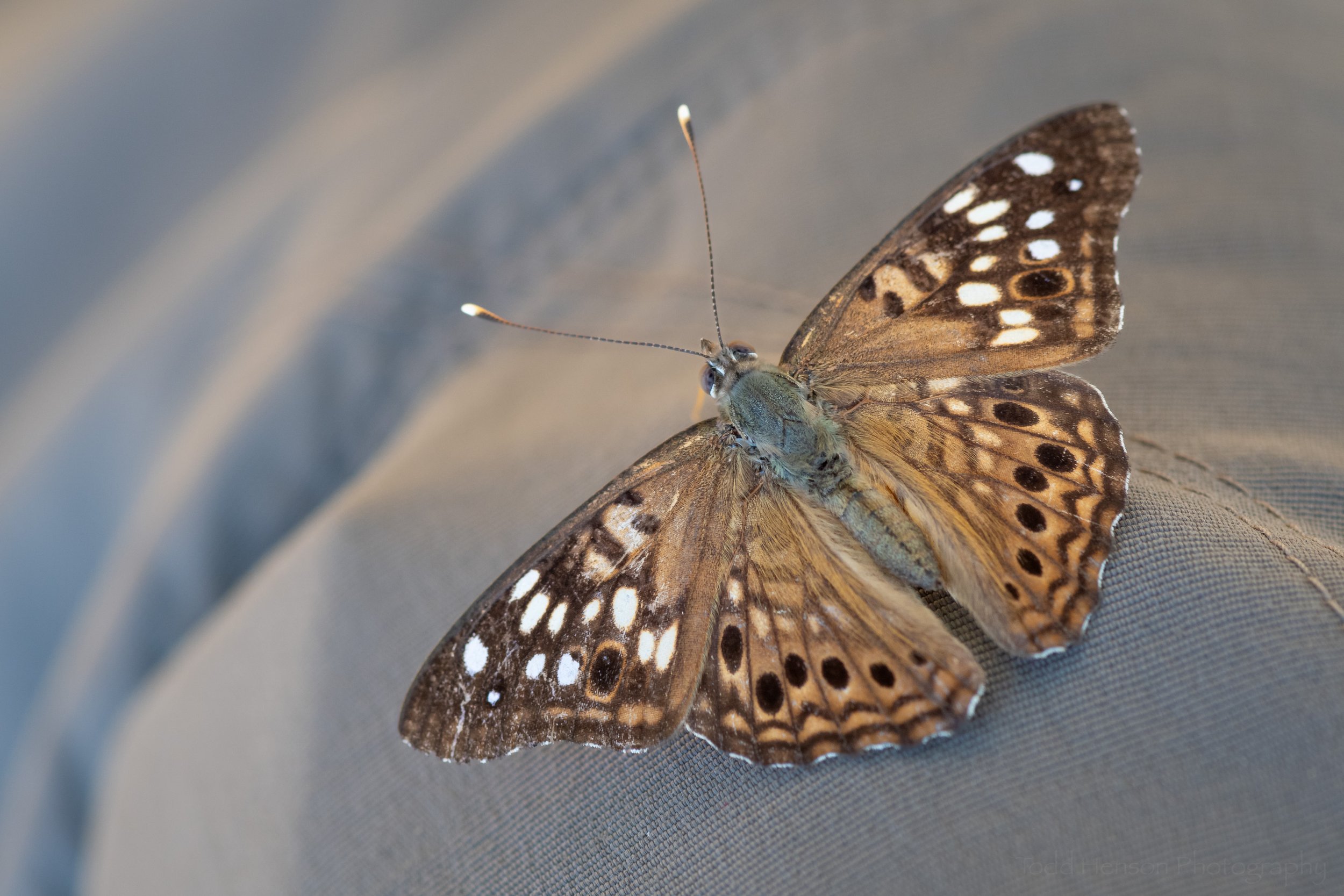
Skipper Butterfly at Dyke Marsh Wildlife Preserve by Todd Henson

Skipper Butterfly (possibly Zabulon or Hobomok) on a leaf at Dyke Marsh Wildlife Preserve in Alexandria, Virginia.

Here is a small Skipper butterfly I photographed at Dyke Marsh Wildlife Preserve in Alexandria, Virginia. I believe it is a Zabulon Skipper, but it might be a Hobomok Skipper. There are so many species of Skipper and some can be difficult to tell apart.

Skippers tend to be small butterflies, and they have a distinctive look when they land, often folding up their wings in little triangular patterns. They are called skippers because of how they fly, quickly skipping around.

I found this one perched on a leaf in some brush along a trail that parallels the edge of the Potomac River, with a small wooded area just beyond. I’ve read the males often sit on leaves watching for females, so perhaps this was a male Skipper.

If you happen to know exactly what species of Skipper this is please comment below and let me know. What markers did you use to identify it?


Do you enjoy these posts?

Sign up to receive periodic emails with updates and thoughts. Don’t worry, I won’t spam you. And please consider purchasing artwork or products from my online store, and using my affiliate links in the sidebar to the right when shopping online.

I appreciate your support!

First View of a Yellow-breasted Chat by Todd Henson

Yellow-breasted Chat perched on a thorny branch.

During the spring and summer I often hear Yellow-breasted Chat singing in the fields of a local wildlife refuge, but I rarely see them. They usually stay hidden down in the brush, only rarely surfacing.

I was fortunate one day to be positioned in the right place at the right time with my camera set up on a tripod and aimed out into the field where a chat would periodically sing. It isn’t a song like other song birds, but more a series of different sounds and easy to pick out as uniquely that of a chat.

It popped up out of the brush and landed on a thorny branch. I saw the movement and quickly turned the camera towards the motion. I managed to find the chat and lock on focus before it disappeared. I only captured one or two images before it flew back down into the brush. I was excited as this was the first time I’d had the opportunity to photograph a chat, and thankfully I captured a decent image of it.

As you can see, the Yellow-breasted Chat is a beautiful bird. It is one of the many species of warbler that migrate through this area each year, and according to the Peterson guides it is the largest in North America. Peterson’s A Field Guide to Warblers of North America indicates it is also a somewhat unusual warbler, being far more secretive that other warblers. Its song is distinct and unlike any other warbler, and it has a large and thick bill compared to the others.

Resources

The links below are affiliate links and I will be compensated if you make a purchase after clicking on my links. This is at no extra cost to you.

If you’d like to learn more about Yellow-breasted Chat, or any other warbler species, check out A Field Guide to Warblers of North America, one of the Peterson Field Guides. It’s over 650 pages, all devoted to warblers.

Or, if you’d like a more general field guide to birds look at the Peterson Field Guide to Birds of North America. This is my favorite birding field guide. Another great one is the Kaufman Field Guide to Birds of North America. See my Resources page for more info on the field guides I use.


Do you enjoy these posts?

Sign up to receive periodic emails with updates and thoughts. Don’t worry, I won’t spam you. And please consider purchasing artwork or products from my online store, and using my affiliate links in the sidebar to the right when shopping online.

I appreciate your support!

Remember to Look Down by Todd Henson

Eastern Box Turtle in the grass.

In a previous post I talked about keeping your eyes open while hiking, about staying aware of your surroundings. It’s easy to overlook opportunities if you’re too focused on looking straight ahead.

This post follows a similar theme. I encourage you to look down once in a while while you’re hiking. Often there won’t be anything down there that catches your eye, but if you don’t get into the habit of looking down you may miss golden opportunities.

If we hadn’t looked down we wouldn’t have seen this Eastern Box Turtle making its way across the trail. It was almost across the trail when we found it. But it saw us and froze, as turtles often due, retracting into its shell. We kept a little distance and stayed still, allowing the box turtle to become a little more comfortable with us, at least enough to pop its head back out far enough for a couple portraits.

Closeup of Eastern Box Turtle in the grass.

After making a few photos we went on our way and allowed the box turtle to continue its trip across the path. I didn’t want to draw too much attention to it and risk it getting injured. Box turtles are thought to be on the decline due to things like habitat loss, death on roadways, and people taking them home as pets, so we need to do what we can to help them survive.


Do you enjoy these posts?

Sign up to receive periodic emails with updates and thoughts. Don’t worry, I won’t spam you. And please consider purchasing artwork or products from my online store, and using my affiliate links in the sidebar to the right when shopping online.

I appreciate your support!