Field Notes Update

Winter Heat Wave Heron by Todd Henson

A Great Blue Heron with beautiful plumage seen atop a tree felled by a beaver in the woods of a wetlands park.

Most of the Great Blue Herons migrate south for the winter, but some choose to stick around Northern Virginia, a potential risk if it happens to be a bad winter. But so far this has not been a bad winter, in fact we just recently had a heat wave that brought temperatures up around 70 degrees Fahrenheit in mid-January. This must have pleased the herons still in the area.

While hiking my favorite wetlands park during this heat wave we stumbled across one special Great Blue Heron, or at least one I found to be special. First off, we encountered it back in the woods, not out on the open wetlands lake. Granted, the water does sometimes extend into the woods, as it was this day, but most of the herons I’ve seen have been around the open water.

The Great Blue Heron seen through the trees, standing atop a fallen tree.

The heron was perched atop a tree felled by one of the local beavers. It was watching the water below, keeping a keen eye on anything moving below the surface. It was far enough away from the trail not to be disturbed by people passing by, even loud children. At one point we watched as it stretched out its long neck, leaning towards the water, preparing to strike… Only to slowly bring its neck back in and once again stand straight on the tree. Apparently its prey had moved away.

Another element that made this particular Great Blue Heron special to me was its fantastic plumage. Look closely at those beautiful long white feathers displayed on its chest and along its back. I always love the opportunity to watch, study, and photograph birds with such beautiful plumage. It just makes me smile.

In this image we can see the Great Blue Heron straight on, a different view than the typical profile shots.

We slowly moved down the trail as my father would move ahead and point out locations that had interesting views of the heron. I photographed from several of these locations, looking for different backgrounds, trying to find cleaner compositions, something that can be a challenge in a wooded environment. In most locations I kneeled down on the ground, trying to shoot from the herons height, or below it.

At one point the Great Blue began stretching, so I stayed still and took advantage of the motor drive to capture as many images as I could of this behavior. I knew from past experience this often preceded shaking and preening, behaviors I love capturing. In the images you can see examples of the stretching, which was following by shaking, where the heron literally shakes its entire body back and forth, puffing up its feathers, before settling back down. After the stretching, shaking and puffing the heron began preening, where it stretches into all sorts of interesting positions to maintain its feathers, cleaning, straightening, perhaps plucking old damaged ones.

The Great Blue Heron stretches one leg and wing. Look closely at the foot of the leg being stretched.

The Great Blue Heron stretching both wings and puffing its feathers just a bit.

I enjoy watching Great Blue Herons shake back and forth, airing out those feathers.

After shaking the Great Blue Heron begins preening.

The final feature that made this Great Blue Heron special was its feet, or more specifically one of its feet. Look closely at the images and you may see something unique about its left foot. I’ve included some zoomed in details to give you a better view. The heron is missing all its front toes on that one foot. It only has the single back toe. I suppose it’s possible this could be a birth defect, but my guess is it waded too close to one of the many large snapping turtles that inhabit this wetlands. The turtles are very quiet and move very slowly, just as herons do. They wait for something to move within reach, then they stretch out their long neck and grab at the prey, whatever it is, again, just as herons do. It can be a tough world out there, but in this case the heron appears to get along fine without the toes. I do wonder, though, if the missing toes might be why it was deeper in the woods instead of out on open water?

A zoomed in closeup showing the herons feet. The left foot, seen here on the right, is missing all its front toes. You can see the back toe standing out behind.

A zoomed in closeup showing the missing toes on the Great Blue Herons left foot. It only has the single rear toe.

These situations are always difficult for me to walk away from. Sometimes I’ll stay put until the animal moves away, provided I’m not stressing it by being there. If I’m stressing it I move away quickly. In this case the animal wasn’t at all stressed. But herons can stay put for hours at a time. I don’t always want to stay in one spot for that length of time, so eventually we moved on, leaving this special Great Blue Heron standing atop the fallen tree, perhaps continuing to peer below the surface of the water looking for its next meal.

Click on any of the photographs for a larger view.

I hope you’ve enjoyed this look at a special Great Blue Heron. Have you seen similar deformities or injuries in wildlife you’ve observed?


Do you enjoy these posts?

Sign up to receive periodic emails with updates and thoughts. Don’t worry, I won’t spam you. And please consider purchasing artwork or products from my online store, and using my affiliate links in the sidebar to the right when shopping online.

I appreciate your support!

Red Badges of Courage by Todd Henson

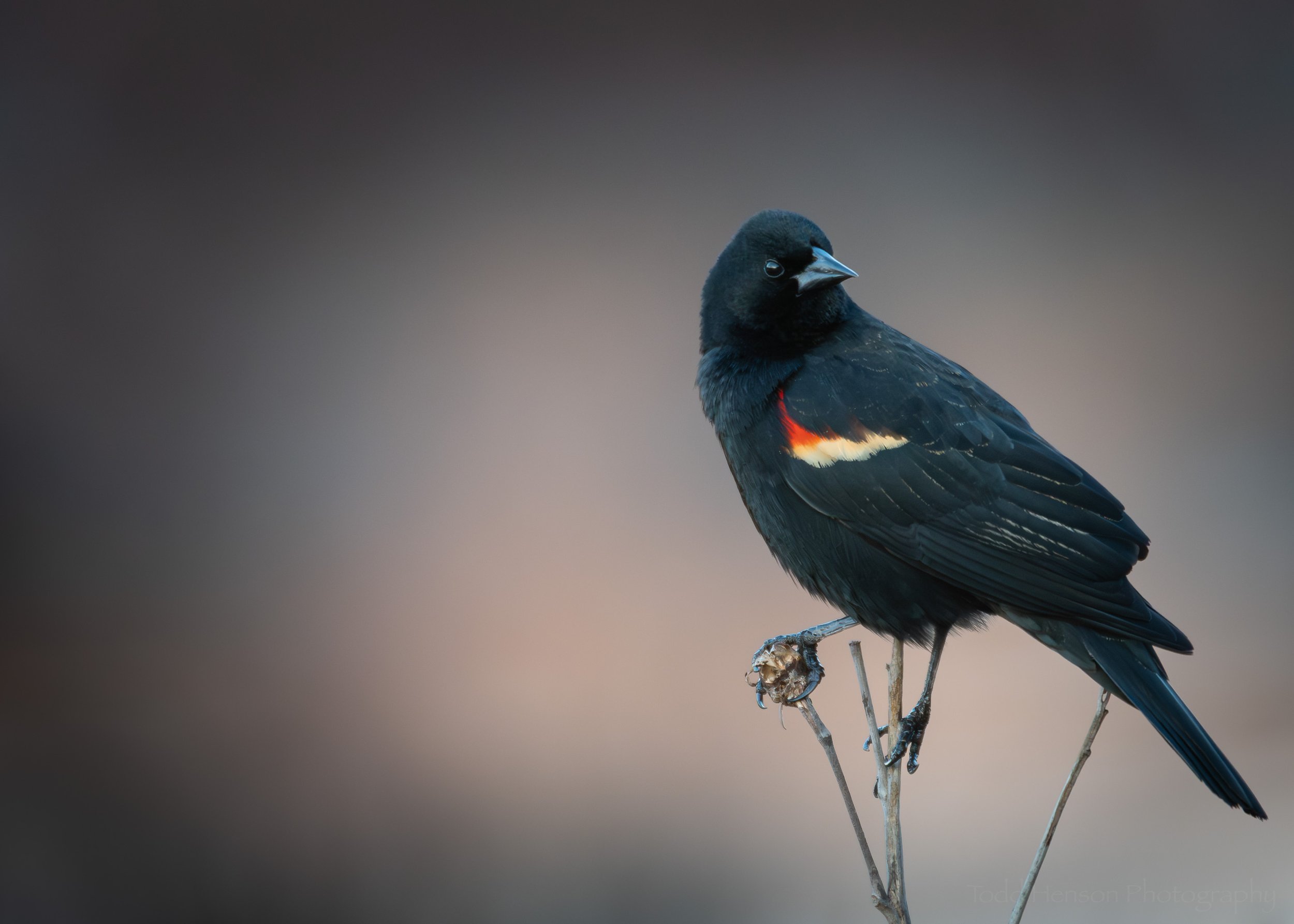
A male Red-winged Blackbird displaying its red epaulettes.

This post contains affiliate links and I will be compensated if you make a purchase after clicking on my links. This is at no extra cost to you.

Some birds, mostly males, have ways of slightly changing their looks, whether to attract a mate or aggressively mark their territory. One such species is the Red-winged Blackbird, a fairly common blackbird with red badges, or epaulettes, on its shoulders. You can often find these birds in large numbers around wetlands areas where they feed and nest. Adult males of the species are easy to identify because they are all black with a red badge on each shoulder, and sometimes a strip of yellow below the red.

This young Red-winged Blackbird (notice it still has brown tips to its feathers) is hiding its red feathers.

Now the young Red-winged Blackbird displays more of its red feathers.

I’ve observed these birds for years, and I was under the impression that some have much larger and bolder red epaulettes than others. I thought perhaps it was related to age, or just genetics. I’d seen some birds with very little red, whereas others had large, bold red badges. But it never occurred to me they controlled how much red was visible, even though it’s obvious when looking back through these photos.

While foraging on the ground this male Red-winged Blackbird covers most of its red feathers.

While calling the male Red-winged Blackbird uncovers its epaulettes and puffs out the red feathers.

A male Red-winged Blackbird showing less of its red epaulet.

Here the male Red-winged Blackbird shows more of the red epaulet while also calling.

I’ve recently been reading a fantastic book about the coloration of birds, titled National Geographic Bird Coloration, by Geoffrey E. Hill. It was here I learned about what is referred to as coverable badges, how some birds are able to cover their strongly colored feathers. The example he used was of Red-winged Blackbirds, and he described how they have a set of black feathers above their red epaulettes, which are the bold red patches of feathers on their shoulders. They are able to cover the red with these overlapping black feathers.

Here we see the male Red-winged Blackbird pushing out its shoulders making the red badge even more visible.

The red epaulettes of Red-winged Blackbirds can be used to attract mates and mark their territory. Hill describes how a male displaying its red epaulettes within the territory of another male is a very aggressive action and one often met with conflict. So the males need to display their red to attract a mate, but may want to hide their red when flying through another males territory. I suspect another time they may hide their red is when gathering nesting material, as may be seen in the photograph below. If a male will be flying back to its nest, I would imagine the last thing it would want is to reveal the location to another male.

A male Red-winged Blackbird foraging for nesting material completely hides it red epaulettes. All that is visible is the yellowish line of feathers below the covered red ones.

In this post I show several examples of male Red-winged Blackbirds showing and hiding their red epaulettes. In some examples you can see they not only control how much of the red is showing, but can also actively puff out the red so it stands above the black feathers. Look closely and you can see they even sometimes push their shoulders out, bringing more attention to those bold, red badges of courage.

See how this young male Red-winged Blackbird puffs out the red feathers of its epaulettes? They extend well above its black feathers.

Here is another view of a male Red-winged Blackbird puffing out the red feathers of its epaulet.

And one final view of those bold, red badges of courage being displayed by this male Red-winged Blackbird.

To learn more about bird coloration check out the book, National Geographic Bird Coloration by Geoffrey Hill, who is an ornithologist and professor of biology. Though intended for a broad audience, this book contains a huge amount of detailed information sure to excite anyone interested in ornithology. It’s not a quick and easy read, nor a college text book, but instead manages to tread that line between the two. I am absolutely loving it!


Do you enjoy these posts?

Sign up to receive periodic emails with updates and thoughts. Don’t worry, I won’t spam you. And please consider purchasing artwork or products from my online store, and using my affiliate links in the sidebar to the right when shopping online.

I appreciate your support!

Brown Creeper in December by Todd Henson

Did I see something in that tree?

Did I just see some movement over on that tree?

Well, now I’m not so sure. All I see is bark.

No, wait, there it is again!

Aha! Now I see it. On the side of the tree. I’ve just found a Brown Creeper.

There it is! Now we can see the Brown Creeper.

As you can see in these photos the Brown Creeper does a remarkable job of blending in when its back is to you. Its feathers are a mottled mix of various shades of brown that perfectly match the bark of the trees it spends almost all its time scaling. And when I say scaling, that’s exactly what it does. The Brown Creeper typically starts at the base of a tree, then slowly spirals up the trunk of the tree, sometimes moving out onto branches. When it reaches high enough it flies back down to the bottom of another tree and starts the process all over again.

These little birds in some ways resemble the body shape of nuthatches, which also spend a lot of time on trees. You will see nuthatches hopping up and down tree trunks, but Brown Creepers are most often seen hopping up the tree.

They spend all this time hopping up trees looking for insects, spiders, or their eggs or pupae, hoping to grab a quick meal. And, of course, they will also nest in the tree, often under peeling bark, though I’ve never seen one nesting.

In Northern Virginia Brown Creepers tend to be some of our winter visitors, having migrated south from more northernly climes. We start seeing them in late fall, maybe October or November. Winter is often thought of as the time when the variety of bird species declines locally, leaving less to see. But species like the Brown Creeper help keep things interesting by showing up as many other species are leaving. So there’s always something to see out there.

Have you ever seen a Brown Creeper? They’re found in large portions of North America, but because of their size and camouflaged feather patterns they can be difficult to see. Just look for movement on tree trunks, especially in well established wooded areas. And keep your eye open for that flash of white underside as they spiral around the side of the tree trunk.

Brown Creepers are marvelous little birds.


Do you enjoy these posts?

Sign up to receive periodic emails with updates and thoughts. Don’t worry, I won’t spam you. And please consider purchasing artwork or products from my online store, and using my affiliate links in the sidebar to the right when shopping online.

I appreciate your support!