Field Notes Update

Katydid Cleaning Itself by Todd Henson

First of a sequence of a katydid cleaning itself.

Second of a sequence of a katydid cleaning itself.

Animals aren’t the only creatures to exhibit interesting behaviors. Insects do, as well. These images are of a katydid cleaning itself much as a cat, dog, or bird would. This process lasted several minutes as the katydid cleaned much of what it could reach, which was mostly its ovipositor.

Third of a sequence of a katydid cleaning itself.

Fourth of a sequence of a katydid cleaning itself.

The ovipositor is the large curved organ at the tail end of the insect used to lay eggs. Different katydid species have differently shaped ovipositors to help them lay eggs in their locations of choice, whether that be on grass stems, under a layer of dirt, in the stems of dead or living plants, etc.

The fibers stuck to the back of this katydid are from the cattails it had been moving through. I found many other katydid in this area, some in the fluffy portions of the cattails. It appeared they may have been eating these parts of the plant.

Fifth of a sequence of a katydid cleaning itself.

Sixth of a sequence of a katydid cleaning itself.

Another characteristic I found interesting in these photos are the katydid’s antennae. Notice how much they move around from image to image, sometimes facing forward, other times straight up, sometimes down.

Seventh of a sequence of a katydid cleaning itself.

Eighth of a sequence of a katydid cleaning itself.

Next time you’re out hiking keep your eyes open for katydid or other interesting insects that are so easy to overlook, but so fascinating when you take the time to investigate.

Please leave a comment below if you can identify this specific species of katydid. I believe it may be a Dusky-faced Meadow Katydid, but I find many of them very difficult to identify.

And if you’re curious what katydid look like in action, I found the following video on YouTube showing a katydid laying eggs.


Do you enjoy these posts?

Sign up to receive periodic emails with updates and thoughts. Don’t worry, I won’t spam you. And please consider purchasing artwork or products from my online store, and using my affiliate links in the sidebar to the right when shopping online.

I appreciate your support!


Photographing Yellow-rumped (Myrtle) Warblers in the Wetlands by Todd Henson

Yellow-rumped (Myrtle) Warbler perched on a branch.

On a recent trip to a wetlands park I was fortunate to watch and photograph several Yellow-rumped Warblers of the Myrtle variety. These are a beautiful bird with a yellow patch on their rump, the top of their head, and on their sides. Their back is grey, and the rest of their body is white with black patches and stripes.

Side and underside of a Yellow-rumped (Myrtle) Warbler in the brush.

I worked to create photographs of these warblers from every angle I could, trying to capture images of their identifying characteristics. This makes it easier to identify the species from field guides.

Yellow-rumped (Myrtle) Warbler facing forward and singing.

Yellow-rumped (Myrtle) Warbler facing forward, head facing the left.

I also worked to create as many pleasing images as I could. In one location I noticed how the warbler would return over and over again to the same set of perches. I found a perspective to shoot this location that gave me a nice, simple, out of focus background. Then I just watched and waited. I readied my camera when the warbler appeared to be returning to the perches I’d seen it use before. And then I began photographing, hoping to capture some nice gestures, some pleasant angles.

Side view of a Yellow-rumped (Myrtle) Warbler perched in the brush.

There is skill in photographing wildlife. Some of that skill is learning the behavior of the animal, learning its patterns and anticipating what it might do next. Some of the skill is knowing your gear, getting it setup and ready.

Yellow-rumped (Myrtle) Warbler perched on a tree, head looking down towards the ground.

But there is also luck in photographing wildlife. You can’t control the animal. It will do what it wants. Luck will play a part in whether you see the gestures you might wish for. Luck will play a part in whether the animal actually does return to the same spot or whether it decides to move on to another location.

Profile of a Yellow-rumped (Myrtle) Warbler perched on a branch.

Finally, patience plays a huge part in photographing wildlife. The animal may very well return to the same location, but it might not do so right away. You may have to wait many minutes, or in some cases hours for the animal to return. It may not return at all that day. You may need to try again another day, over and over again, watching and waiting, but never giving up.

Yellow-rumped (Myrtle) Warbler perched on a tree, getting ready to fly.

A top down view of a Yellow-rumped (Myrtle) Warbler on the side of a tree.

But photographing wildlife is worth it. You get to spend some small part of your day out in nature watching, learning about, and creating images of all these beautiful creatures. It doesn't get much better than that!


Photographing Orchard Spiders (Orchard Orb-weavers) by Todd Henson

Profile image of an Orchard Spider.

About the Spiders

Hiking through the woods can reveal all manner of creatures if you keep your eyes open. One creature I found and photographed in a nearby park is the Orchard Spider, also called the Orchard Orb-weaver. It seems fairly common in this area, as I found quite a few of them on my hike.

The Orchard Spider is a very colorful spider. Its legs are primarily green. The abdomen has a range of colors, from shades of green, to whites and yellows, along with some darker black patterns. The underside of the abdomen can have a very bright splotch of yellow/orange that almost glows in the right light. I wonder if this is used to attract prey to its web, or perhaps to attract a mate?

Underside of an Orchard Spider showing bright yellow patch.

The yellow/orange patch on the underside of this Orchard Spider really glows.

One of the spiders I found had just begun digesting an insect that was caught in its web. Spiders digest their prey outside their bodies by regurgitating digestive enzymes and wrapping their prey in them. This breaks down the prey turning the majority of it to liquid nourishment that the spider drinks, leaving behind any of the larger, indigestible parts. Think of it like the green smoothies some of us drink.

Orchard Spider with prey.

Another image of an Orchard Spider with prey.

Final image of the Orchard Spider with prey.

Photographing the Spiders

I find photographing spiders in the field a real challenge, especially those on webs. The slightest little breeze can cause the web to move. From a distance it may not look as if the spider is moving much in the breeze, but when zoomed way in with a telephoto lens, or sitting very close with a macro lens, these small movements can actually be very large.

My main strategy for photographing these spiders was to shoot a LOT of photographs. I shot 303 photographs to get the 7 photos included in this post. The downside to shooting so many frames is that it does make it more time consuming and difficult to sift through them and find any that might be acceptable.

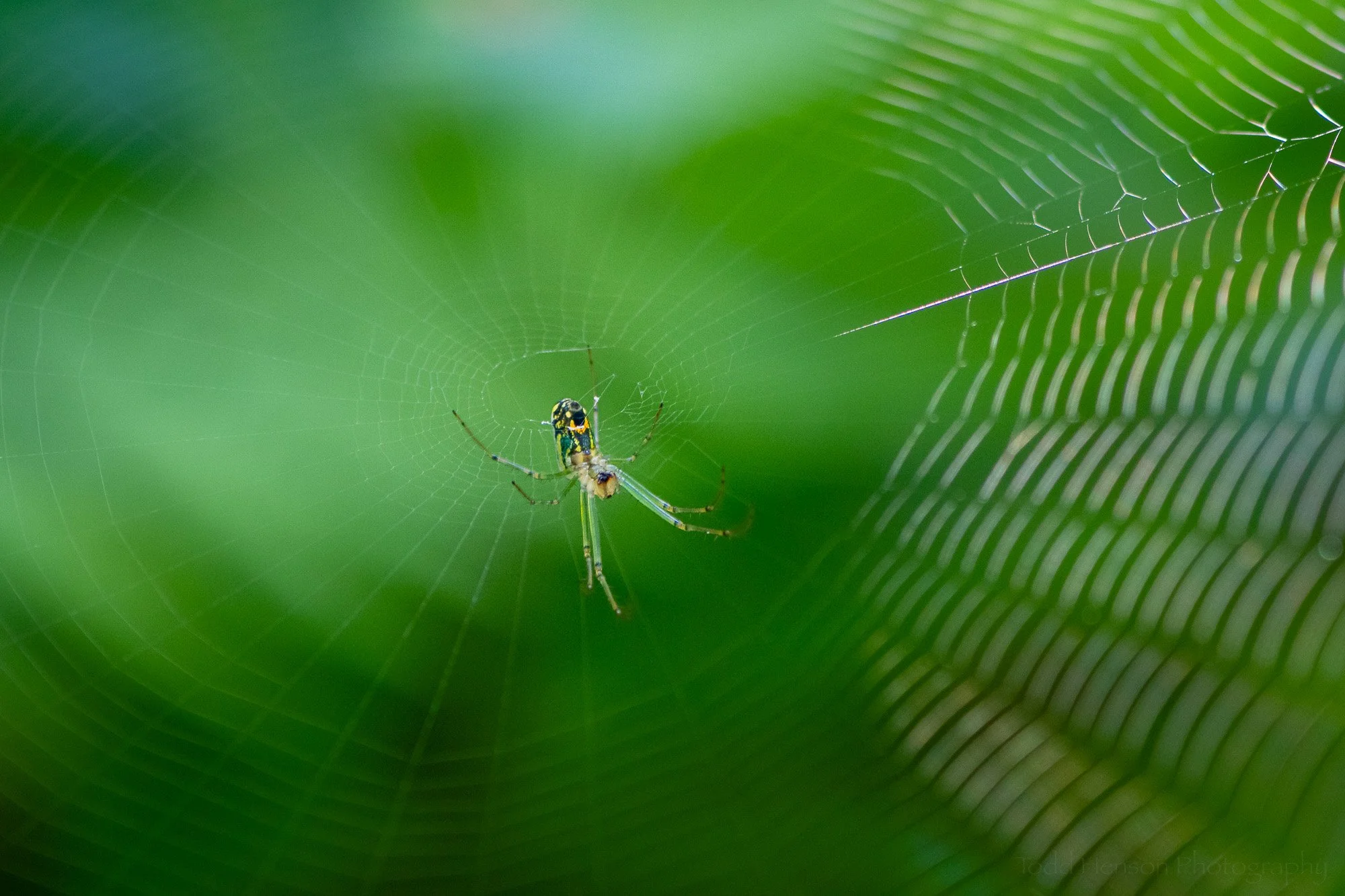
Orchard Spider in its web.

I do the best I can to frame the subject in a pleasing manner, and I try to get the focus as close as I can. It helps to wait until the lulls between breezes when the web may settle down before moving again.

I try to use a fast shutter speed, but I also try to stop down the aperture a little to give me more depth of field and more wiggle room. These two things fight each other. As I stop down the aperture I get a slower shutter speed. That can prompt me to raise the ISO to boost the shutter speed back up to something reasonable. It’s all a balance. If there isn’t much wind you may get away with slower shutter speeds. One of the photos here was shot at 1/13th of a second.

Another important consideration in these sorts of photographs is the background. You typically want a nice, clean background, something that doesn’t distract from the subject. This can be easy to achieve if the subject is far enough from the background. Using a macro lens tends to give a very shallow depth of field. This helps keep the background less distracting. If you use a longer telephoto lens this can also help, especially if you open the aperture wider, which also helps blur out the background. But sometimes you can actually include the background to show the subject in its environment. In the photos here I’ve chosen a clean, out of focus background to help the subject stand out.

Gear Used

The links below are affiliate links and I will be compensated if you make a purchase after clicking on my links. This is at no extra cost to you.

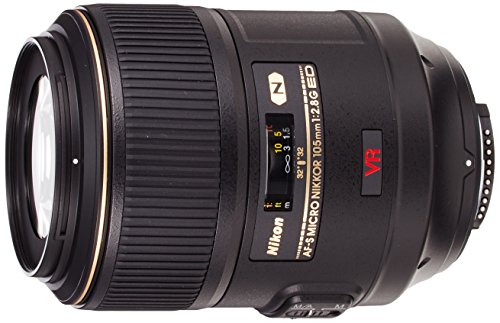
All of these photos were shot with a Nikkor 105mm Micro lens. It’s a very sharp lens and great for macro work. I really enjoy using it. It’s compatible with teleconverters, so you can turn it into a 147mm lens with a 1.4x teleconverter, a 178mm lens with a 1.7x teleconverter, and a 210mm lens with a 2x teleconverter. You can also use extension tubes to let you get even closer to a subject, though the depth of field falls away fast when you use these.

I hope these tips help you in photographing while out in the woods. They can apply not just to spiders, but also other insects and plants or flowers of any sort. If you’d like more tips try my post, 7 Tips for Photographing Insects and Other Little Crawly Things. Now get out there and practice.

If you have any questions, comments, or suggestions feel free to leave a comment below.


Do you enjoy these posts?

Sign up to receive periodic emails with updates and thoughts. Don’t worry, I won’t spam you. And please consider purchasing artwork or products from my online store, and using my affiliate links in the sidebar to the right when shopping online.

I appreciate your support!