Behold the Blue-eyed Grass by Todd Henson

Blue-eyed grass. Isn’t that a beautiful pattern where the blue and yellow meet?

This spring I found many examples of what has become a favorite flower of mine, blue-eyed grass. I find it fascinating it’s called grass as it’s really a member of the iris family, which helps explain the lovely flowers it produces.

I enjoyed the juxtaposition of the bright blue-eyed grass flower against the darker brown of another plant.

I sometimes struggled to photograph these flowers. I love the pattern formed of the transition from yellow to blue inside the flower and so I often wanted to focus on that. I loved the shapes of the petals and so I wanted to highlight those. And as often happens, I was drawn to the anthers so I sometimes focused on those. With the lens I was using and the distances I was at and, of course, the breeze, I often had a very shallow depth of field so I needed to choose what I wanted in focus as I just couldn’t get it all. If the breeze hadn’t been there perhaps I could have done some focus-stacking, but not this time around. This did give the opportunity, though, to really focus in on those single elements. And I do very much enjoy a very shallow depth of field.

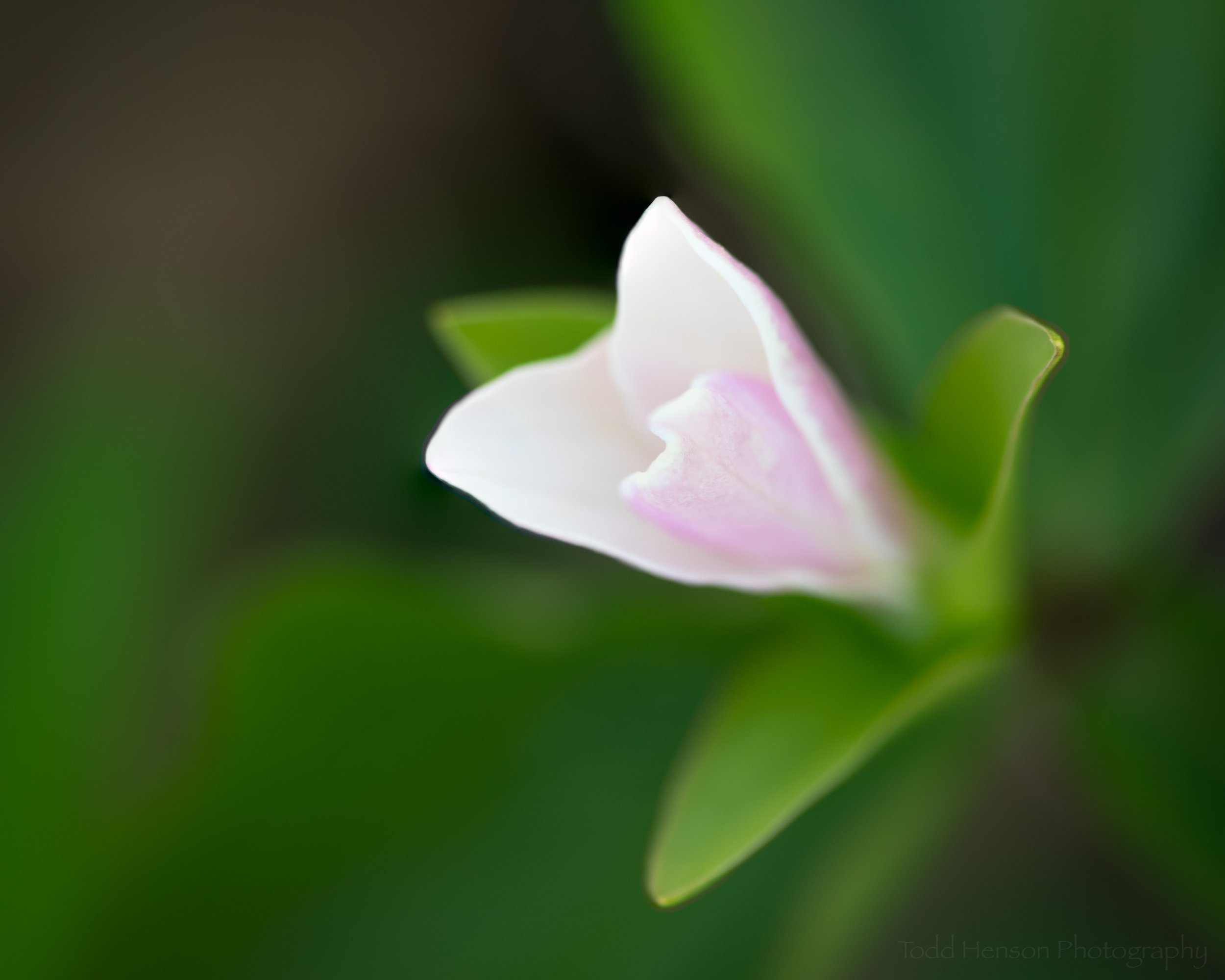
Here I tried to include both the flower and the green bud of blue-eyed grass, though the but is out of focus.

A different arrangement of flower and bud of blue-eyed grass.

I don’t know what specific species of blue-eyed grass I photographed, or even whether they are all of the same. There are several species here in Virginia and many more can be found all over the United States and Canada. Check out Linda Leinen’s Lingering Bits of Spring to see examples of dwarf blue-eyes grass and annual blue-eyes grass found in Texas. Head over to Stephen Gingold’s Friday Night Flower Night to see an example of eastern blue-eyed grass in Massachusetts. And visit Alexander Kunz’s Sisyrinchium bellum to see an example of western blue-eyed grass in California.

A closeup of the beautiful anthers of blue-eyed grass.

I created these photographs on May 25th of 2022, all in the same general location. In fact, this is the same location where I photographed pink lady’s slipper orchids. It can be a very productive location and I look forward to more opportunities in the future to photograph these amazing little flowers. I hope you’ve enjoyed some of these views of blue-eyed grass. Let me know what you think in the comments below.

Here I really liked how close the blue-eyed grass grew to the branch, almost as if it were a part of it.


Do you enjoy these posts?

Sign up to receive periodic emails with updates and thoughts. Don’t worry, I won’t spam you. And please consider purchasing artwork or products from my online store, and using my affiliate links in the sidebar to the right when shopping online.

I appreciate your support!

Painting with Woodland Waters by Todd Henson

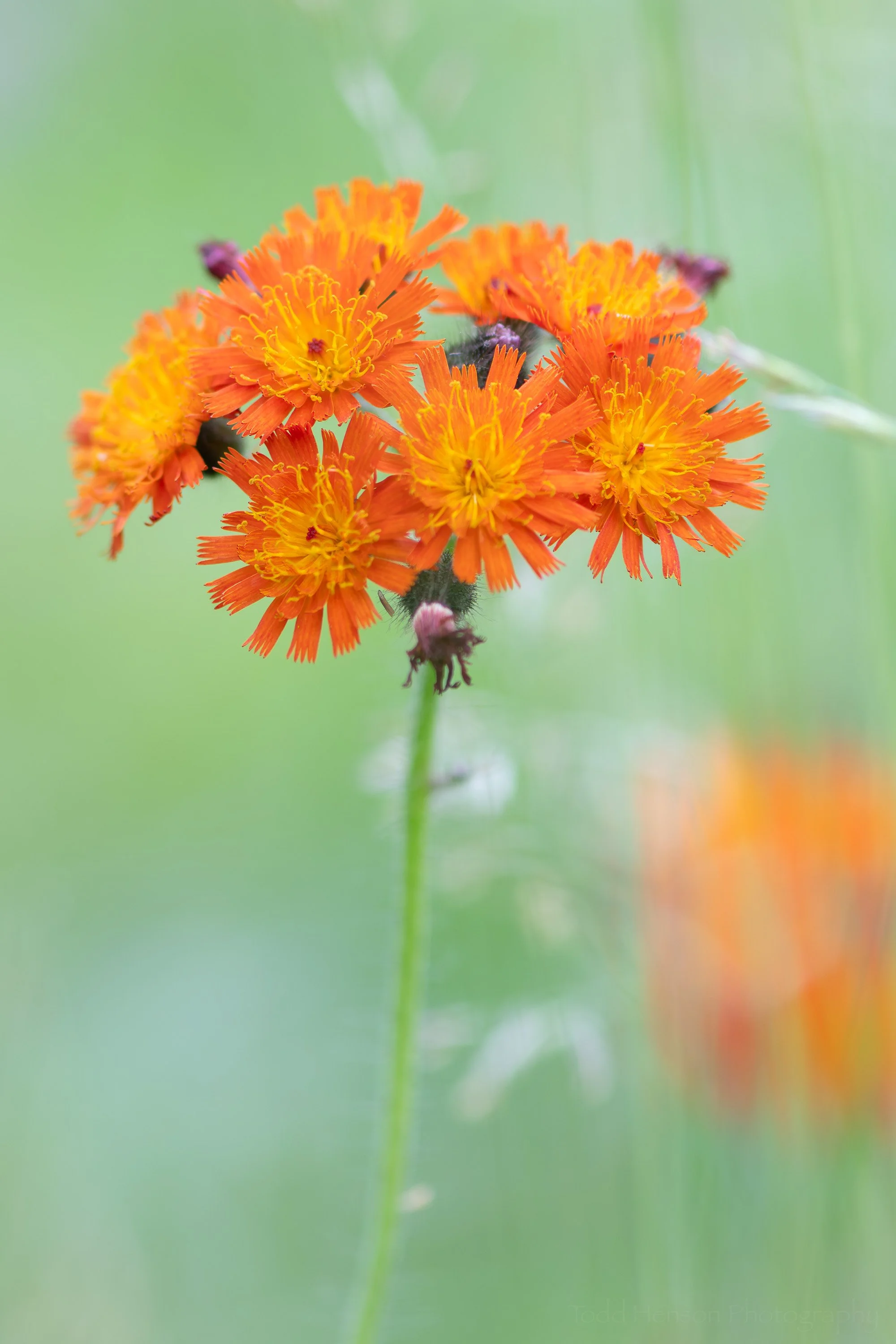
Woodland Waters

Most often I go hiking and photographing in the morning, and mostly on weekends. But every so often I have the opportunity to go in the afternoon on a weekday. Either I have the day off or I take off work early, grab my gear, and head out in search of new images. In this particular case it was mid-May and I’d left work early with a specific goal in mind, one that has nothing to do with today’s photograph. I was working on a post that would show the stages of growth of pink lady’s slipper orchids and I wanted to check in on the flowers, see how they were progressing this season. But as this post will demonstrate, it can be beneficial to stay open-minded to other opportunities as they present themselves, to keep your eyes open and to practice those skills that help you find interesting subjects.

With all that in mind, this trip also resulted in the recent post, One Afternoon Six Critters. While on my way to and from the location of the lady’s slippers I happened upon a number of interesting critters, mostly insects but also a lizard. And of course I took the time to stop and photograph each of them. Thankfully, I’d started my hike just after 1 pm so I had plenty of time to hike, and being mid-May it was still cool enough I wasn’t worried about overheating and I had plenty of water.

As I’m sure you can guess, today’s photograph also came out of this hike. Many of these trails are along a small creek and sometimes something catches my eye in the water or on its surface. The sun was positioned such that it was lighting up the trees on the far side of the creek while leaving the water in shade. This created what I thought were some interesting and painterly reflections. That’s one of the elements that often draws me to reflections, how they can create an almost painterly feel to a photograph. I also like how, being a reflection, they have a slightly different perspective than if we were looking at the actual scene above the water. And if you add in the element of clear water flowing in a shallow creek such that you can see some of the rocks below the surface, you get this great combination of elements.

One thing I found interesting about this trip were the number of images I created of each subject. I often create many images both to try to get something in focus and to try different compositions, different angles and perspectives. So it was no surprise to me that I created 32 images of the eastern tailed-blue butterfly, or 40 images of the black-and-gold flat millipede, or 22 images of wild geranium (by the way, the post Considering Composition for a Wild Geranium also resulted from this hike). But I’m very surprised I only created 2 images of these creekside reflections. Why? Thinking back, I’m not entirely sure. Perhaps I didn’t think they’d result in much so didn’t spend time on them. Or perhaps I was happy with that single composition and didn’t feel the need to explore. It’s also possible I was tired, though just after this I found the millipede and took the time to create 40 images of it.

In the end I don’t know why I created only 2 images of the creek, but I’m glad I stopped long enough to at least create those. The more I sit with this image the more I like it. I don’t know if it will work as well for you, but please let me know whether or not it does in the comments below.


Do you enjoy these posts?

Sign up to receive periodic emails with updates and thoughts. Don’t worry, I won’t spam you. And please consider purchasing artwork or products from my online store, and using my affiliate links in the sidebar to the right when shopping online.

I appreciate your support!

Eastern Tiger Swallowtail Caterpillar by Todd Henson

An eastern tiger swallowtail caterpillar

Butterflies and moths are some of the fantastic creatures that begin their lives in very different forms, that of caterpillars. I’m not yet very good at identifying caterpillars but some of them are very distinctive, which can help. In this case we have a green caterpillar with what appears to be a large bulbous head with large yellow and black “eyes” and a yellow stripe around its neck and some blue spots around its body. Of course, a lot of this is just decoration, likely to make it appear less appetizing to any nearby predators.

Look at those “eyes” on the eastern tiger swallowtail caterpillar

I was fortunate to find this beautiful eastern tiger swallowtail caterpillar

After a bit of online searching it appeared I’d found the caterpillar for an eastern tiger swallowtail butterfly, one of the common and very beautiful species we see here in Virginia. The butterflies can be largely yellow or largely black but I’ve no clue how to tell from the caterpillar which it would become. As luck would have it, the first butterfly I photographed this year was a yellow eastern tiger swallowtail, so here’s a view of it resting on some leaves of the forest floor. We saw the butterfly in early April and the caterpillar in late May

My first view of a butterfly in 2022 happened to be a yellow eastern tiger swallowtail

When I returned to the site of the caterpillar a couple weeks later it was gone. The entire leaf was gone. I had hoped to find the leaf curled up with the chrysalis inside. I’ve read they can stay in chrysalis form for approximately 1 to 3 weeks, so it is possible I was too late. It’s also possible something happened to it. Perhaps it became a meal or a person walking along the boardwalk took it. I’m hopeful it managed the transformation to a butterfly, and I’m glad I had the opportunity to view and photograph it.

This was my first encounter with an eastern tiger swallowtail caterpillar. Have you seen any of these before?


Do you enjoy these posts?

Sign up to receive periodic emails with updates and thoughts. Don’t worry, I won’t spam you. And please consider purchasing artwork or products from my online store, and using my affiliate links in the sidebar to the right when shopping online.

I appreciate your support!