Ebony Jewelwing by Todd Henson

A male ebony jewelwing damselfly

Sometimes you really have to work to get even a mediocre photograph of a subject. That happened with this one, an ebony jewelwing damselfly. We were hiking through the woods when we turned right onto one of the dirt roads that led back to the car. Not far along that section of wooded road I noticed this very dark damselfly, one I don’t recall seeing before. Every other damselfly I’d seen had mostly clear wings, but this one’s were black. And the body was a beautiful metallic blue. At the time I had no idea what specific species it was so I went about capturing some photographs hoping it was unique enough to allow easy identification later (it was).

This particular damselfly appeared a bit jumpy and I didn’t have a very long lens with me, just my 105mm macro lens. So I attempted to slowly approach it a number of times and almost each time it would fly off just as I got close enough to get a decent photo. But eventually we were able to work together. I moved slowly enough and perhaps it became used to my presence. So I have this single image to share of the ebony jewelwing perched atop a blade of grass.

This particular individual happens to be a male, which have the metallic blue body and all black wings. The female is more of a brown color and has white spots at the tips of the wings. Like all damselflies this one was a fast mover, quickly flying from one perch to another, very difficult to follow in flight with the camera. I have done that before with some larger dragonflies but it’s very much a challenge, and one I didn’t succeed at this time around.

The trail was somewhat dark and I had to handhold to follow the damselfly so I set my ISO high, to 1250. I had a reasonably open aperture, f/5, giving me a shutter speed of 1/2500 second. When it landed it tended to stay reasonably still, so I might have gotten away with a slower shutter speed and a lower ISO (for less noise) or smaller aperture (for more depth of field), but I didn’t want to risk it and didn’t have a lot of time to think through changing settings. There is some noise, but I think it works perfectly fine as a natural history sort of image to show you an example of this magnificent species.


Do you enjoy these posts?

Sign up to receive periodic emails with updates and thoughts. Don’t worry, I won’t spam you. And please consider purchasing artwork or products from my online store, and using my affiliate links in the sidebar to the right when shopping online.

I appreciate your support!

A Return Visit to Voorhees Nature Preserve by Todd Henson

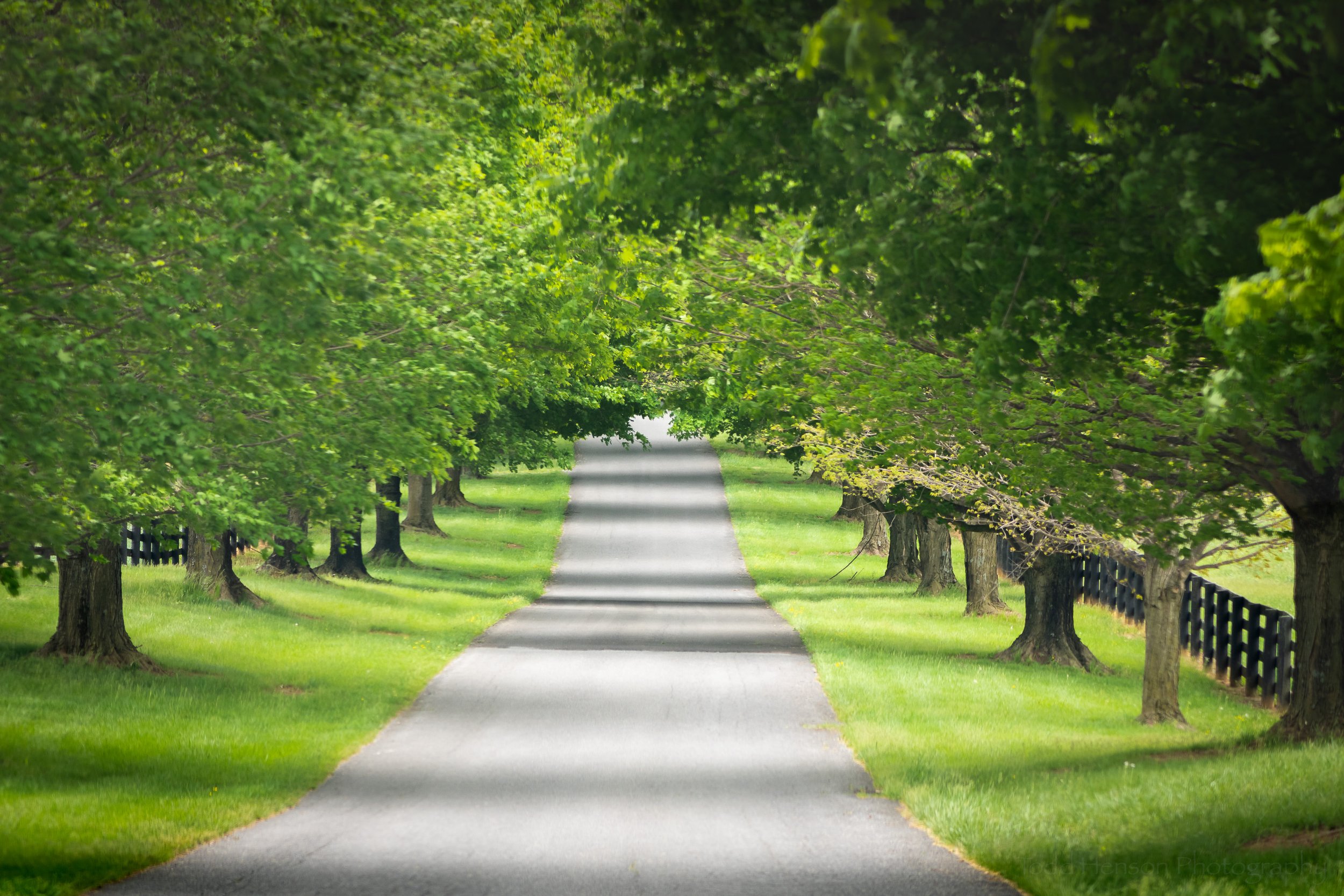
The entrance road to Voorhees Nature Preserve. There’s only a very small amount of parking, so plan accordingly and arrive early.

It’s always nice returning to a location, getting to see how it’s changed and what else it has to offer. Several months back, in early to mid-July, my father and I visited Voorhees Nature Preserve and enjoyed what we found enough we wanted to return, even after being chewed on by chiggers. This time I learned my lesson and put on some bug spray before we entered the woods, though it is getting cool enough bugs should become less of an issue until spring.

I will warn you up front, the majority of the photos I created during this trip were of fungi growing along the trails. But keep reading and you’ll see a couple other species (some that move) and a view of the Rappahannock River.

Tis the Season for Fungi

I loved this view of the small mushroom

We couldn’t believe all the mushrooms we found along the trail. It was almost impossible to walk the trail without stepping on some of them. And there were quite a variety, as well. Unfortunately, I’m not yet very good at identifying fungi, so I’ve done the best I can with some of the variety here, and I welcome any corrections or additions if you’re more experienced with these species.

We saw several bluish-purplish mushrooms, ones I don’t remember seeing before except in other folks photos. I believe they might be viscid violet cort mushrooms.

A mushroom and an acorn. This might be a viscid violet cort mushroom.

I’ve no idea what species the mushrooms below are, but I was fascinated by how they were growing around the fallen pine cone. And if you look very closely you might notice they’re even growing out of the pine cone.

A pine cone planter

I love pine forests. The forest floor always looks so beautiful with all the dried out brown pine needles fallen from the trees. And apparently, some mushrooms enjoy the nourishment, like this grouping of what might be downy milk cap mushrooms.

What might be downy milk cap mushrooms growing from a bed of pine needles

I don’t know what the species below is, and I didn’t do a good job of photographing all the mushrooms from multiple angles to assist with identification. Sometimes, as in this instance, I just photographed what caught my eye. And here it was the underside of the mushroom showing off all the gills.

Viewing the gills

Most of the mushrooms looked somewhat soft. But the mushroom below was an exception, sporting a shiny top that appears a bit more rigid.

This darker brown mushroom has what appears to be a harder shiny top

Another mushroom found amongst the pine needles was the orange-brown mushroom below. There were several in the area with another out of focus in the background.

An orange-brown mushroom growing through the pine needles

And speaking of orange, that’s exactly what caught my eye below. I saw that little ball of orange almost completely hidden from view. I don’t know what it is, but I do wonder if perhaps it’s a Caesar’s mushroom just emerging from the ground.

Could this be a Caesar’s mushroom just emerging from the ground?

Below we found a grouping of mushrooms that look almost slimy. They were growing out the side off a cut tree beside the trail. Could they be golden pholiota?

Perhaps a group of golden pholiota?

Below is another fascinating fungi, this time growing as a ring around a branch. There were several layers of it, and I loved that green ferns happened to be in the same area.

A fungal ring

Perhaps the most unusual species of mushroom we saw, at least to us, were the bluish ones below. They just didn’t look right. They almost looked as if they might be infected with something else causing that bluish color. But after a little research I wonder if these might be indigo milk cap mushrooms. One of them has a small slug feeding from the top of it.

A small slug feeding from the top of what might be an indigo milk cap mushroom

Blue and green

And the Frogs Were A-hoppin!

An Eastern cricket frog on a leaf

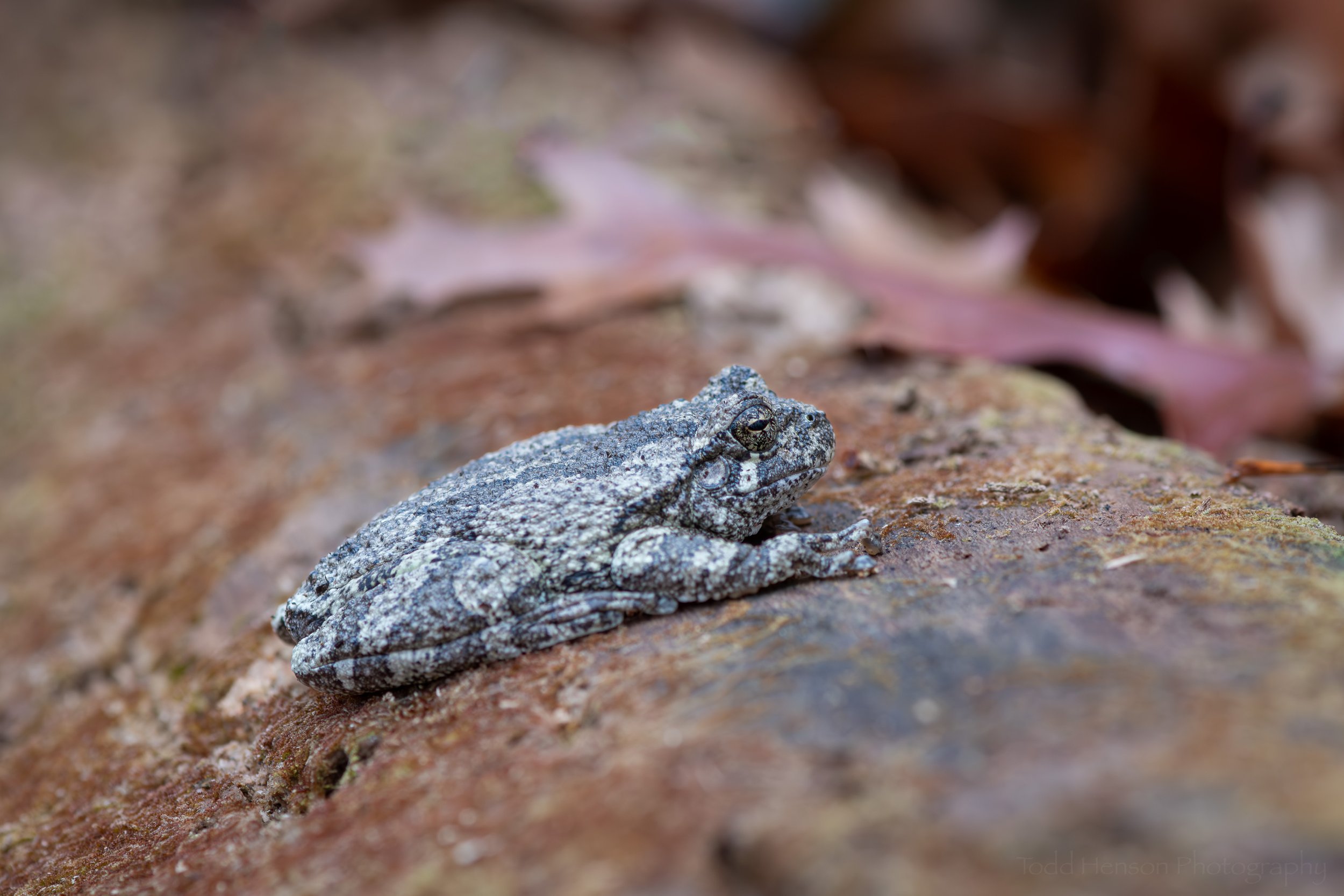
On our last visit we were amazed by the numbers of small toads along the trail. They were like the mushrooms during this trip, all over the place and a challenge not to step on. We didn’t see nearly so many this time. And to be honest, I don’t know for certain if we saw any. Most of what we saw was very small and hopped away before we could get a good look. Because of how far and fast they hopped I suspected they might be frogs, and when I got home and looked closer at a couple of the photos I believe at least some of what we saw were Eastern cricket frogs. I didn’t manage to get a single photo of a frog that was fully in focus. It was somewhat dark in the woods, and I was handholding the camera. I could have done better with the mushrooms if I’d used a tripod, but a tripod wouldn’t have worked with the frogs. There were just too skittish.

Great Big Orange Spider

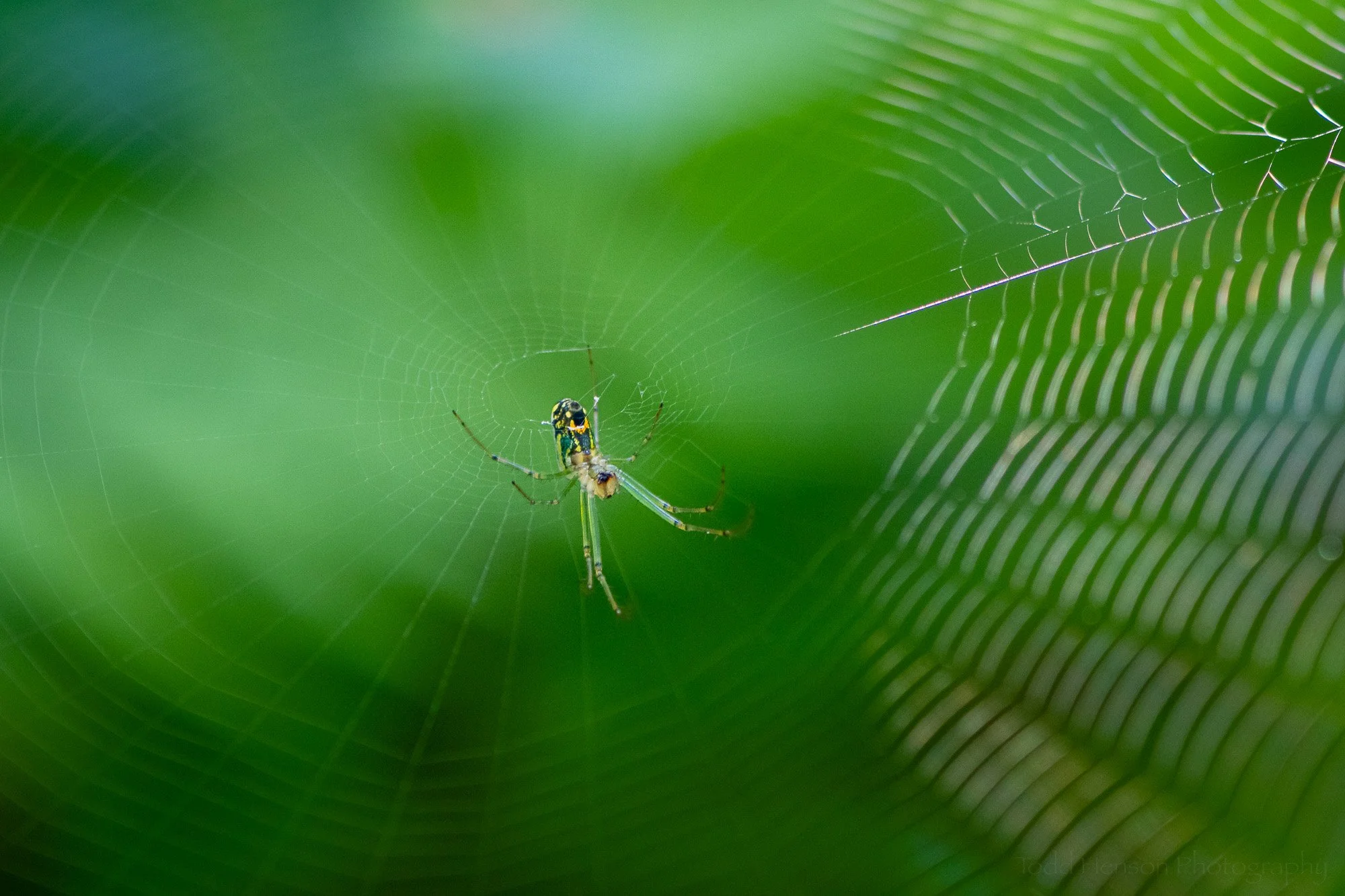
A marbled orb-weaver, also known as a pumpkin spider

Viewing the marbled orb-weaver from the side

Spiders are all over the woods, sometimes making their webs right across the trail, leaving them for us unwary hikers to walk right into. But in this case, thankfully, the large web was just to the side of the trail. I noticed it because of the spider right in the center of the web, with a large orange body and black markings on its back. This is a marbled orb-weaver, sometimes called a pumpkin spider because it can resemble a pumpkin. After I’d gotten a top down shot I worked at getting as close to the side of the web as I could without hitting it so I could capture a side view.

The River View

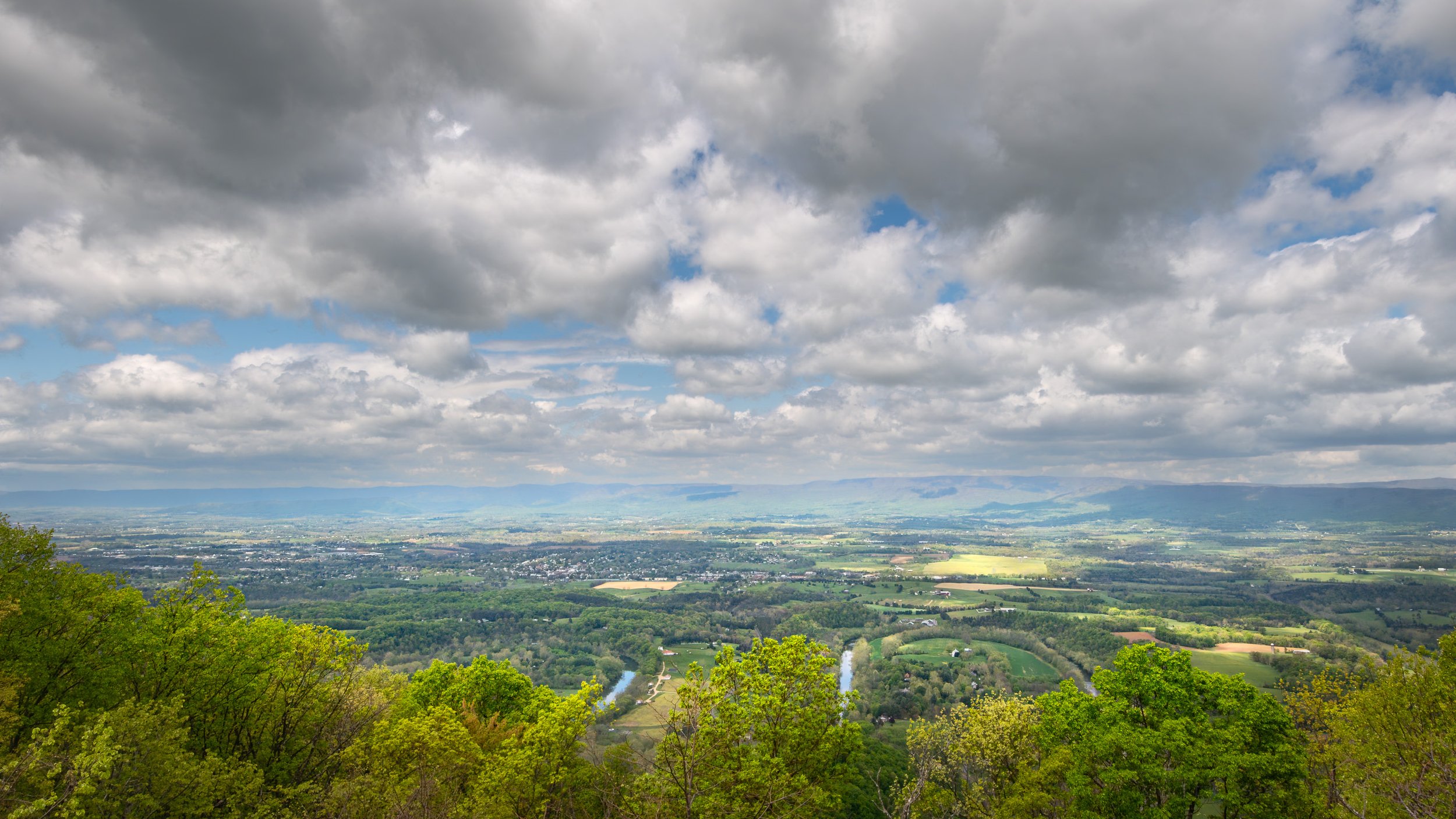
Overlooking the Rappahannock River

Last time we visited we took the pond trail. This time we opted for the river trail. It started out very level, but later took us downhill to a small, almost dry, creek. We laughed that it must be the river view the sign out front had advertised. But we kept walking and eventually the trail turned to the left and began going steeply uphill. When we reached the top we saw the first overlook of the Rappahannock River. You can see it in the distance, as well, as it winds back and forth. We both thought it might have been nice if we’d arrived maybe a week or so earlier to get a little more color in the trees across the river, but at least there was still a little to see in late October.

Highlight: SNAKE!

A garter snake on the forest floor

One of the highlights of this trip for me came very near the entrance on our way back out of the preserve. I was down on the ground photographing a mushroom when I noticed an interesting pattern just beyond. When I looked more closely I realized I was right next to a garter snake! I know this is a somewhat common snake, but I get excited anytime I have the opportunity to photograph snakes in the wild, and I thoroughly enjoyed the brief time we spent with this one. As you can see they blend in fairly well, even when in the open as this one is.

In this photo the snake is a bit agitated, and none too happy with our presence right near it. While trying to get closer with the camera the snake actually struck out at me and I was surprised by its reach. I also noticed it flattened its head making it look perhaps a little more like a viper, hoping to scare us away. It was also very actively flicking its tongue trying to get our scent. I was very happy to have captured this in the photograph. After spending a brief time creating some photographs we went on our way, leaving this beautiful snake in peace.

So what did you think of our return trip to Voorhees Nature Preserve? We had a great time and hope to return again. The river trail is actually much longer than what we hiked and we’d like to hike a bit more of it at some point.


Do you enjoy these posts?

Sign up to receive periodic emails with updates and thoughts. Don’t worry, I won’t spam you. And please consider purchasing artwork or products from my online store, and using my affiliate links in the sidebar to the right when shopping online.

I appreciate your support!

Captured Falling Leaves by Todd Henson

A Captured Falling Leaf

One of the scenes we expect to see in some areas during autumn are all the leaves falling from the trees. And perhaps we have a desire to capture some of the leaves on camera, as they are falling, to freeze that action and show the leaf midway to the ground. How do we do that? Well, there are a number of ways, but today we’ll take a light hearted look at one particular method that if I’m honest with you, might be considered cheating. But I ended up having a lot of fun with it, just the same.

Forever Falling, Never to Touch the Earth

Take a close look at the photos in this post. Do you notice anything strange or unusual about the leaves you see, each hanging in mid-air? I will say there was no cheating in software. This was all done in camera and the leaves were each captured mid-air. This also didn’t involve multiple exposures. Each photo is a single exposure, with no in-camera “trickery.”

This technique won’t work with every falling leaf. In fact, it will only work with a very small and rare subset of leaves. It’s not specific to any particular shape, species or color of leaf. But it does depend a bit on location, and involves a fair bit of luck and perhaps a bit of effort searching for those special leaves.

A Loner Leaf Above All the Rest

Have you figured out how it was done? If not, I’ll give one last clue. Click on the photos to open them in a larger view. Then look closely around each leaf. Do you see it? Last chance before I tell you how it’s done.

Ready? Ok. We found each of these leaves hovering right in front of us along the trail. They had been falling at one point, but when we found them they’d at least temporarily stopped their falling and just hovered there. How can that be? Well, the woods are full of spiders and many spiders build webs between trees along the trail. I’ve often walked right into these spider webs, sometimes later finding the spider crawling on my clothing. Well, in this case a leaf happed to get caught by some of the spider silk, and the silk was strong enough to stop the falling of the leaf, so now it hovers there, resisting gravity, slowing swaying or twirling in any light breeze. Each time I found a leaf like this I took advantage of it and created a few photographs to show the leaf hovering in the air.

See? You don’t need any fancy gear to capture a falling leaf in a photo. Just a bit of luck and good observational skills finding those rare leaves that have been captured by spider silk. 😁


Do you enjoy these posts?

Sign up to receive periodic emails with updates and thoughts. Don’t worry, I won’t spam you. And please consider purchasing artwork or products from my online store, and using my affiliate links in the sidebar to the right when shopping online.

I appreciate your support!