Today I wanted to travel briefly to the land of inspiration, that place we go both when we’re actively looking for ideas to explore, and when we simply want to bask in its possibilities, enjoying the time we spend there and perhaps hoping we’ll absorb some small part of what we experience, that we’ll find a way to weave it into our artistic pursuits, whether they be photography, painting, writing, music, woodwork, or any of the other infinite variety of creative endeavors.
The land of inspiration is vast and takes many forms. One of my favorite is that of books, of any topic or genre. The photograph above shows one small section of my collection of books. This section happens to include a wide range of material collected in a semi-organized fashion, but as you can see, still in an overflowing and somewhat haphazard mess.
I don’t actually own a television anymore, though I know that is another source of potential inspiration. I used to have an old CRT, if you remember those, sitting in the enclosure to the left, where photography books now rest. Here you’ll find the works of Steve McCurry, Art Wolfe, Sebastião Salgado, Edward Steichen, Michael Kenna, and many others, as well as books of photographic instruction. I look to these to show me some of what is possible in the world of photography, to show what has been done, and to find ideas or concepts I might like to explore in my own work.
Behind the photography books I have an old poster of Neuschwanstein Castle in Germany, purchased at the castle gift shop, reminding me of a wonderful trip to that location, of walking through the castle and around the castle grounds, learning some of the history of the location and the people who lived there. This was such an incredible location, very beautiful, and provided inspiration for many buildings that came later, such as several of the castles at the various Disney theme parks.
Look again and you may find books of artwork by Keith Parkinson, M.C. Escher, Steve Hanks, among others. I love looking not just at the work of photographers, but that of artists of any kind. You never know when something you see in a painting may inspire you to create something in a completely different medium. There are writing books that attempt to teach the art and craft of creatively putting words together, of pulling from within and sharing our thoughts with the world. Hidden in the stacks are books about nature and wildlife and the people for whom these are their passion.
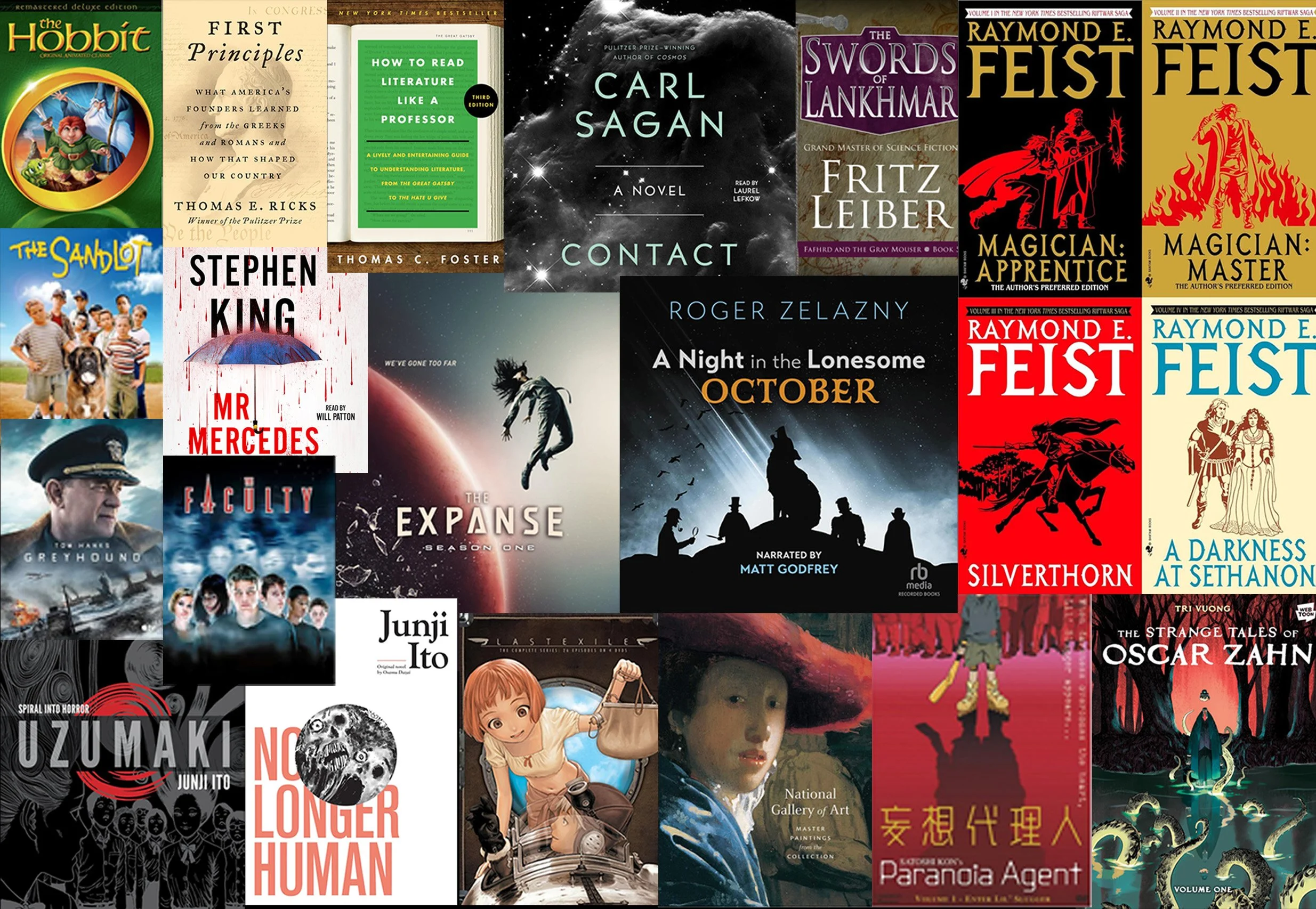
The majority of the books are works of fiction. Most of the visible books I’ve yet to read. I often put two rows of books on each shelf when they’ll fit, with books I’ve read hidden in the back row so I can see the books I still want to read. And, as is obvious, sometimes the books don’t fit on shelves, so I stack them in front in a very haphazard fashion, trying to place books I most want to read near the top where I’ll see them every day. Books like The Bear and the Nightingale by Katherine Arden, Ararat by Christopher Golden, The Monk of Mokha by Dave Eggers, Arctic Dreams by Barry Lopez, and many, many others. Some of these books create and share entire worlds, surfacing visions and ideas I might not have otherwise had. How many of these visions and ideas might one day inspire something within me?
Reading is a key player in my land of inspiration, and I think it could have a place in most anyone else’s, as well. What does your collection of books look like? Perhaps it takes the form of the stacks in a public library? Do you have any books you long to read, or ones you go to repeatedly for inspiration?