Broad-headed Sharpshooter (Oncometopia orbona) by Todd Henson

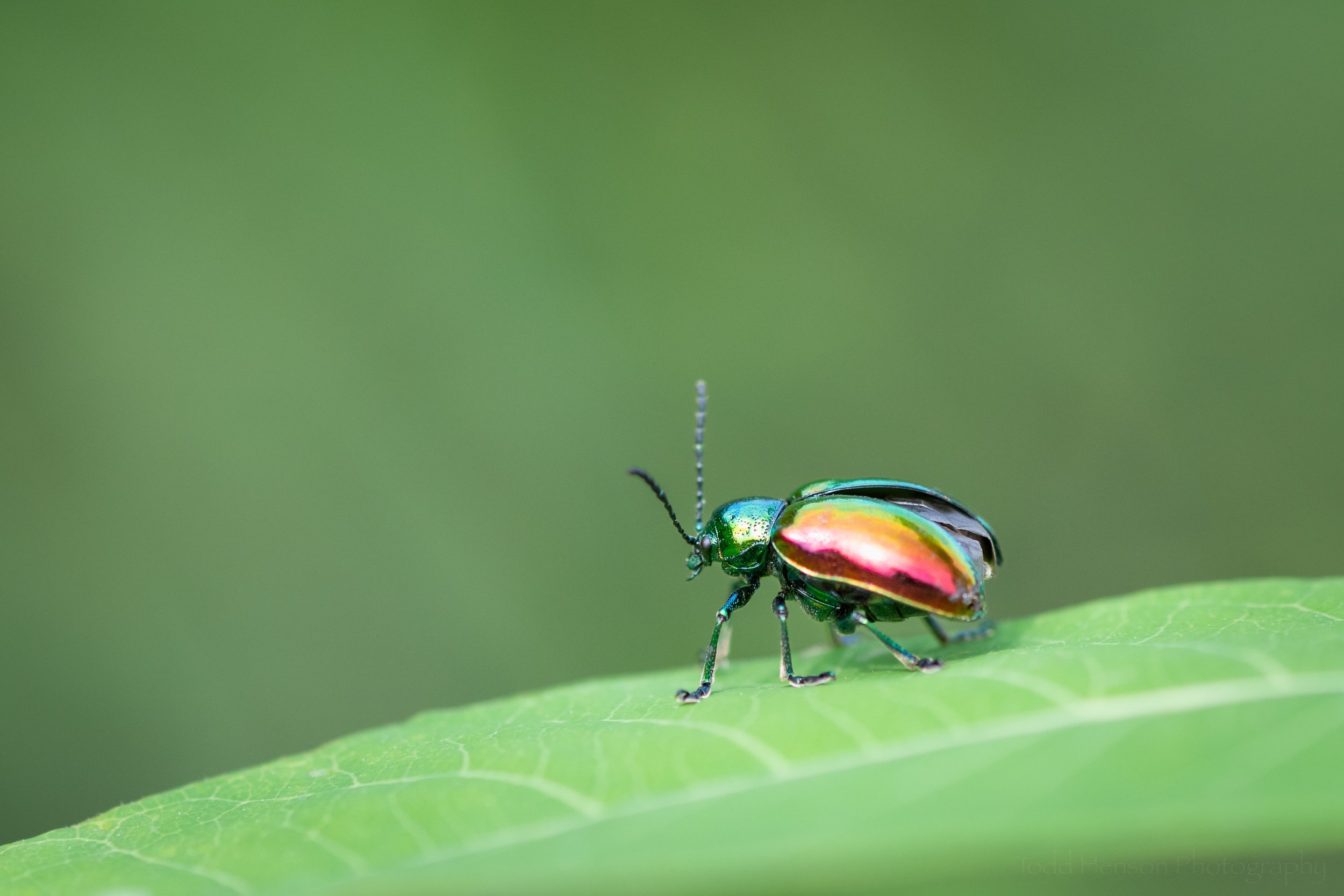
A broad-headed sharpshooter (Oncometopia orbona) resting on a leaf

Today we take a brief look at a very interesting looking insect, one that’s not uncommon but that many of us may not have seen before. This is a broad-headed sharpshooter (Oncometopia orbona), a type of sharpshooter and in the family of leafhoppers. As you may be able to tell from the names these insects are able to hop or shoot quickly away from a plant. They also typically feed on plants, essentially drinking liquid from them. Unfortunately, this particular species is also known to carry a bacterium that causes disease in grapevines in some regions.

This particular sharpshooter was photographed at the end of July, 2021, at Blandy Experimental Farm, the State Arboretum of Virginia, a fantastic location for lovers of plants and all the things you can find around plants. There were large fields of plants and that’s where I happened to notice the interesting coloration and patterns of this insect.

Cropped in to get you a little closer to the broad-headed sharpshooter

Look closely and you may notice an interesting feature of this specific insect. I believe this is a female broad-headed sharpshooter. How can I tell? The females can sometimes be seen with white milky or waxy patches on the sides of their wings. The patches are called brachysomes and contain proteins they’ll scrape onto their eggs to help protect them from drying out and from some predators. I think the small patches of white on the wings and the rear legs of this sharpshooter might be the remains of this substance, so she may have recently laid some eggs somewhere.

In the past I’ve shared photos of another sharpshooter, a Versute sharpshooter on the leaves of an hibiscus.

Have you seen one of these broad-headed sharpshooters before? And if so, where did you find it?


Do you enjoy these posts?

Sign up to receive periodic emails with updates and thoughts. Don’t worry, I won’t spam you. And please consider purchasing artwork or products from my online store, and using my affiliate links in the sidebar to the right when shopping online.

I appreciate your support!

Snowberry Clearwing Moth by Todd Henson

Snowberry clearwing moth on thistle

In a recent post about the hummingbird clearwing (Hemaris thysbe) I’d mentioned that it wasn’t the only clearwing moth in the area, so today we take a look at another, the snowberry clearwing (Hemaris diffinis). Both of these species are known as hummingbird moths for their resemblance to hummingbirds. If you don’t look closely, or aren’t aware of their existence, it can be easy to confuse one for the other.

Looking at the back of a snowberry clearwing feeding on thistle nectar

The primary differences between the snowberry and the hummingbird clearwing, as mentioned in the previous post, are the black legs on the snowberry (versus pale colored on the hummingbird) and the dark band around the eyes and down the side of the snowberry. Both can have an olive-greenish toned thorax, but as you can see, one of these snowberry has less green in it, instead featuring a more tan or golden thorax. There is some variation in each species appearance.

The benefits of a long tongue become obvious when watching this snowberry clearwing feeding

Some of these photos are not as in focus as I’d like. These little hummingbird moths are quite challenging to photograph as they constantly move about from flower to flower, feeding on nectar. But I’m hopeful the photos help show just how much of the wing can be clear, hence the clearwing in their name.

In this photo the snowberry clearwing has just finished feeding and is moving away from the flower. Notice how its tongue begins to curl inwards.

The other feature I’d like you to notice is their long tongue, used to reach into deeper flowers much as hummingbirds do. As the snowberry clearwing moved away from a flower it had just been feeding from it curled up its tongue. I don’t know if this is typical behavior, though I suspect it is.

The snowberry clearwing has moved further from the flower after feeding and we can now see its tongue more tightly curled.

If you happen to live in the eastern half of the United States then keep your eyes open for snowberry clearwing hummingbird moths. You just might see one. I don’t see them all that often, but each time is a joy. I hope you’ve gotten some enjoyment viewing these wonderful little flying marvels.


Do you enjoy these posts?

Sign up to receive periodic emails with updates and thoughts. Don’t worry, I won’t spam you. And please consider purchasing artwork or products from my online store, and using my affiliate links in the sidebar to the right when shopping online.

I appreciate your support!

Variations on a Theme: Mid-May Blooms by Todd Henson

Variations on a Theme: Mid-May Blooms

For this look at variations on a theme we explore different ways of finishing exactly the same photograph. This was prompted by a comment from Lashaan of Bookidote on the post, A Flowering Shrub One May Morning, where he wondered how the photos might look in a black and white rendition. So I decided to experiment with one of the photos and see what I could do with it.

Color Version

Mid-May Blooms: Color Version

We begin with the color version. I’ve always been more of a color photographer, I see in color, I’m drawn to color. So most of my photography is processed as color. In this case I love the green background, how the white flowers stand out against it, and the subtle pinks and yellows in some of the flowers. I’m very happy with this photograph.

Low Key Black & White Version

Mid-May Blooms: Low Key Black & White Version

My first thought when interpreting this photo in black and white was to create a low-key image with a dark background and beautiful white flowers. Something bold and dynamic. Something that helped the flowers jump off the screen. It creates a particular feeling from the photograph, and I found I liked this version, as well.

High Key Black & White Version

Mid-May Blooms: High Key Black & White Version

What naturally followed my thoughts of creating a low-key image? Well, of course, creating a high-key image, one much lighter and perhaps a bit more ethereal and soft. Yes, the flowers are white, but that doesn’t mean we can’t create a very soft light grey for the background. The flowers still stand out, but it creates a much different feeling from the photograph. I find I also like this version.

Mid-Tones Black & White Version

Mid-May Blooms: Mid-Tones Black & White Version

Finally, I ended up creating an image that was somewhere between the two previous versions, creating something that perhaps feels closer to reality. This version relies on a nice range of mid-tones, nothing too dark or too light, creating a more balanced image. As you might have guessed, I like this version, too.

Thoughts

There are an almost unlimited number of ways to process any photograph. Even if your goal is to recreate reality as closely as possible there’s still so many choices to make, and very few of us can perfectly remember exactly how a scene looked, so our attempts to recreate it might naturally vary.

Another option is to ignore reality and instead process the image based on your emotions, how you felt about the scene instead of how the scene looked. This can lead to photos that still look real but might not perfectly match the actual scene that day. Or it can lead to images that look very different from that day.

When you decide to process a photograph in black and white it opens an entirely new treasure box full of possibilities. Most of us don’t see in black and white, so any image we create in black and white will be very interpretive. As with color, you can create something that we’ll feel looks real, or you can create something very different from the color source.

When shooting in raw mode our cameras capture all the color information and save it in the image file. We can choose to interpret the photo in black and white by shifting each of the colors to some shade of grey. And as the different versions above show, your choices can create vastly different final images.

I hope you’ve enjoyed this short look at four different versions of the same image. There are countless other ways this image could have been interpreted, and that’s both some of the fun and frustration of post-processing. We have to choose.


Do you enjoy these posts?

Sign up to receive periodic emails with updates and thoughts. Don’t worry, I won’t spam you. And please consider purchasing artwork or products from my online store, and using my affiliate links in the sidebar to the right when shopping online.

I appreciate your support!